
Protein in a child’s urine, medically called proteinuria, does not always mean that the child has kidney disease. Small amounts of protein may appear temporarily during fever, illness, dehydration or intense physical activity. Some children, particularly adolescents, have a harmless condition called orthostatic proteinuria.
However, persistent proteinuria, especially when accompanied by blood in urine, swelling, high blood pressure or changes in kidney function, may require further medical evaluation.
The first step is usually to confirm the urine finding and determine whether it is temporary or persistent. A first-morning urine sample is particularly useful.
This article explains the possible causes of proteinuria in children, the tests used to investigate it, warning signs and situations in which specialist kidney assessment may be appropriate.
Healthy kidneys contain tiny filtering structures called glomeruli. These structures help remove waste products and excess fluid from the blood while retaining most proteins needed by the body.
Proteinuria occurs when more protein than expected is found in urine.
The presence of protein may be associated with changes in kidney filtration, but it can also occur temporarily in otherwise healthy children.
Proteinuria is often first detected during a routine urine examination. A child may have no symptoms, and the result may be an incidental finding.
One positive urine dipstick result does not automatically establish kidney disease. Repeat testing and assessment of the child’s medical history help determine whether further investigation is necessary.
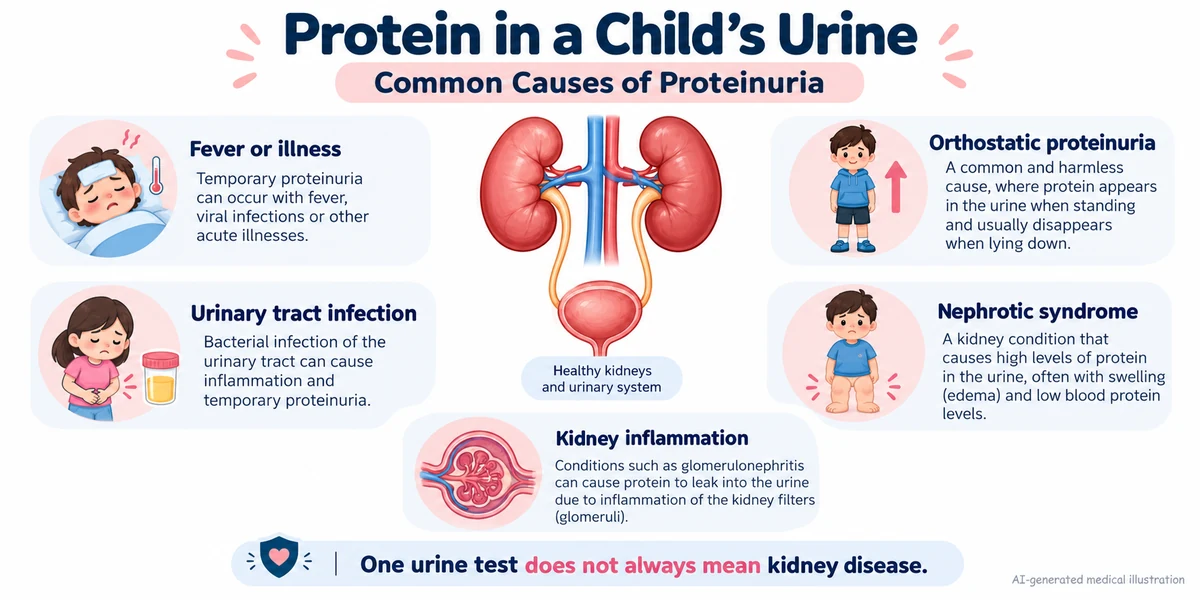
Proteinuria has several possible causes. Some are temporary and harmless, while others are associated with kidney disorders.
Transient proteinuria means that increased protein appears in urine for a limited period and later resolves.
Possible triggers include:
Fever or acute illness.
Dehydration.
Strenuous physical activity.
Physical stress.
Other temporary physiological changes.
For example, protein may be detected during a febrile illness but no longer be present when the child has recovered.
Clinicians may recommend repeating the urine examination after the illness resolves.
Temporary proteinuria does not usually require kidney-specific treatment when no other abnormalities are present.
Orthostatic proteinuria occurs when protein is present in urine while a child is upright but is absent or within the expected range after lying down overnight.
It is particularly common in adolescents.
A first-morning urine sample can help identify this pattern because it is collected after the child has spent several hours lying down.
In otherwise healthy children, confirmed isolated orthostatic proteinuria is generally considered benign and does not require medication.
The clinician may advise periodic reassessment according to the individual situation.
A urinary tract infection (UTI) may be associated with abnormal urine findings, including protein and sometimes blood.
Symptoms can include:
Pain or burning during urination.
Increased urinary frequency.
Fever.
Abdominal discomfort.
Cloudy or unusually smelling urine.
A urine examination and, when indicated, urine culture can help identify infection.
Treatment depends on the child’s age, symptoms, test results and clinical condition.
Nephrotic syndrome is an important kidney condition that can cause substantial protein loss through urine.
It typically involves significant proteinuria and low blood albumin, often accompanied by swelling.
Possible symptoms include:
Puffiness around the eyes, particularly in the morning.
Swelling of the feet, legs or abdomen.
Rapid weight gain related to fluid retention.
Foamy urine.
Reduced appetite or tiredness.
Minimal change disease is a common cause of nephrotic syndrome in young children, although other kidney diseases can cause it.
Nephrotic syndrome requires medical assessment. Treatment depends on the underlying condition and may involve prescribed medicines and monitoring.
Glomerulonephritis refers to conditions involving inflammation or injury of the kidneys’ filtering structures.
Some forms may develop after an infection, while others are associated with immune-system disorders.
Possible findings include:
Protein in urine.
Blood in urine.
Swelling.
High blood pressure.
Reduced kidney function.
The severity and treatment vary according to the underlying disease.
Persistent proteinuria may also occur in children with:
Certain inherited kidney disorders.
Structural or congenital kidney abnormalities.
Chronic kidney disease.
Other medical conditions affecting kidney filtration.
Persistent proteinuria may sometimes be associated with underlying kidney disorders. Understanding the difference between Acute and Chronic Kidney Diseases can provide useful background about kidney function abnormalities and their evaluation.
The presence of proteinuria alone does not identify which condition is responsible.
Yes. Many children with proteinuria appear healthy and have no noticeable symptoms.
Temporary and orthostatic proteinuria are often found during routine investigations rather than because of a specific complaint.
Some kidney disorders may also develop before obvious symptoms appear.
This is why repeat urine testing, blood pressure measurement and clinical review can be more informative than symptoms alone.
| Feature | Temporary proteinuria | Persistent proteinuria |
|---|---|---|
| Duration | Resolves on subsequent testing | Remains present on repeated tests |
| Possible causes | Fever, illness, exercise or dehydration | Kidney filtering disorders or other conditions |
| Symptoms | Often absent | May be absent or accompanied by other findings |
| Testing | Repeat urine examination | Urine quantification and additional assessment |
| Management | Often observation after resolution | Depends on cause and associated findings |
Orthostatic proteinuria is a separate, usually benign pattern that may recur in daytime samples while remaining normal in first-morning urine.
The distinction is established through testing rather than appearance of the urine alone.
Persistent foamy urine may sometimes be associated with increased protein in urine.
However, foam can also appear because of urine flow, concentration or other non-disease factors.
Foamy urine alone cannot confirm proteinuria.
If foam is persistent, particularly when accompanied by swelling or other symptoms, medical assessment and a urine examination may be appropriate.
Blood in urine is called hematuria.
It may be:
Visible hematuria: Urine appears red, pink, brown or tea-coloured.
Microscopic hematuria: Blood is detected through laboratory examination but cannot be seen with the naked eye.
Possible causes include urinary tract infections, kidney stones, urinary tract abnormalities and certain kidney filtering disorders.
Blood and protein appearing together may increase concern for a kidney-related condition, especially when accompanied by hypertension or reduced kidney function.
Visible blood in urine should be medically evaluated even when the child does not have pain.
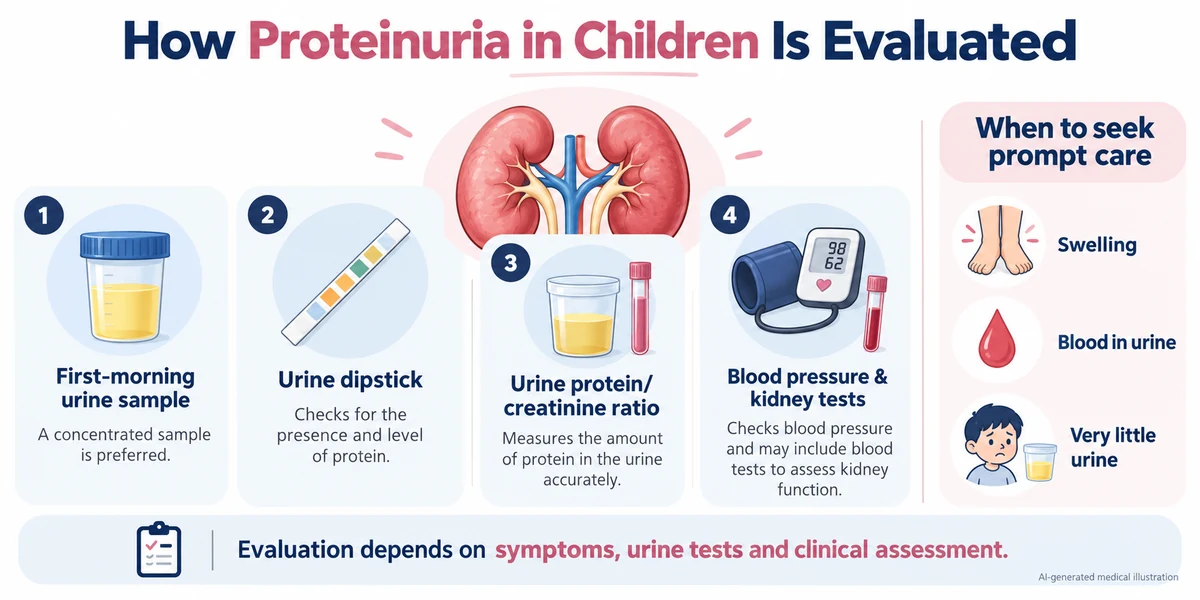
A urine dipstick is commonly used to screen for protein and other urine abnormalities.
It is quick and requires a small urine sample.
However, dipstick results can be influenced by urine concentration and other factors.
A positive result may need confirmation.
A first-morning urine sample is collected immediately after waking, before the child begins normal daytime activities.
It helps distinguish orthostatic proteinuria from proteinuria that persists overnight.
Depending on the findings, the clinician may request urinalysis and a urine protein-to-creatinine ratio from this sample.
The urine protein-to-creatinine ratio estimates the amount of protein in urine relative to creatinine.
It is commonly used to quantify proteinuria in children without requiring a 24-hour urine collection.
The interpretation depends on the child’s age and other clinical findings.
The urine ACR test measures albumin relative to creatinine.
It may be useful for evaluating certain kidney disorders and monitoring kidney health.
However, the urine protein-to-creatinine ratio is frequently used in the assessment of childhood proteinuria because different types of protein may be present.
The appropriate test depends on the suspected condition.
Blood pressure is an important part of evaluating kidney health in children.
Unlike adult blood pressure classification, readings in younger children are interpreted using age, sex and height-related reference values.
Repeated abnormal readings may require further assessment.
When indicated, blood investigations may include:
– Serum creatinine.
– Estimated glomerular filtration rate (eGFR).
– Electrolytes.
– Serum albumin.
– Blood count.
Complement levels or other immune-related investigations.
The choice depends on the child’s symptoms, urine findings and suspected cause.
Ultrasound may be recommended to assess kidney size, structure and certain urinary tract abnormalities.
It is not necessary for every child with a single positive urine dipstick.
A kidney biopsy involves examining a small sample of kidney tissue.
It may be considered in selected children when the diagnosis remains uncertain or when particular clinical findings suggest a kidney disease requiring tissue examination.
A biopsy is not routinely necessary for temporary or isolated orthostatic proteinuria.
When a clinician requests a first-morning urine sample, the family should follow the laboratory’s specific collection instructions.
General steps include:
Use the sterile or appropriate collection container supplied by the laboratory.
Collect the urine when the child first wakes up, before normal daytime activities.
Follow the recommended clean-catch method when age-appropriate.
Close the container securely.
Deliver the sample according to laboratory instructions.
For infants and younger children who cannot provide a clean-catch sample, healthcare professionals may recommend a different collection method.
Collection practices matter because contamination can affect interpretation.
The urine protein-to-creatinine ratio is often reported in mg/mg, although laboratories may use other units.
General reference thresholds include:
| Child’s age | Commonly used UPCR threshold |
|---|---|
| 6–24 months | Up to approximately 0.5 mg/mg |
| Older than 24 months | Up to approximately 0.2 mg/mg |
These are general clinical reference values rather than universal diagnostic rules.
Interpretation in very young infants requires age-specific expertise. The result must also be assessed alongside urine findings, symptoms, blood pressure and kidney function.
An increased UPCR may require repeat testing or additional evaluation.
Further evaluation may be appropriate when:
– Protein remains present on repeated urine tests.
– First-morning UPCR is above the expected range.
– Proteinuria is accompanied by blood in urine.
– The child has swelling.
– Blood pressure is elevated.
– Kidney function tests are abnormal.
– There is a relevant family history of kidney disease.
– The child has other findings suggesting a systemic or kidney disorder.
The urgency of evaluation depends on the severity of the findings.
There is no single waiting period that is suitable for every child. Significant swelling, reduced urine output or other concerning symptoms should be assessed promptly rather than waiting several weeks for routine repeat testing.
Nephrotic syndrome occurs when the kidneys lose excessive amounts of protein through urine.
The resulting reduction in blood albumin can allow fluid to move into body tissues, contributing to swelling.
Other laboratory findings may include increased blood cholesterol.
The most recognisable finding is often swelling around the eyes, especially in the morning.
Swelling may later involve the legs, feet or abdomen.
A child may also experience changes in appetite, fatigue or increased body weight due to fluid retention.
Diagnosis generally involves urine protein measurements, blood albumin testing and clinical assessment.
Additional investigations are used when indicated.
Treatment depends on the cause and the child’s medical condition.
Many children with idiopathic nephrotic syndrome receive corticosteroid treatment under specialist supervision, but treatment response varies and some children experience relapses.
Other medicines may be considered in selected circumstances.
Families should not start steroid treatment independently.
Treatment depends on the cause.
Temporary proteinuria: Often resolves when the triggering condition has passed.
Orthostatic proteinuria: Usually does not require treatment when the diagnosis is confirmed and there are no concerning associated findings.
Urinary tract infection: May require antimicrobial treatment according to clinical evaluation.
Nephrotic syndrome: May require corticosteroids or other prescribed treatment and follow-up.
Glomerular diseases: Treatment varies with the underlying diagnosis and may involve targeted medical management.
Not all types of proteinuria are reversible, and no treatment guarantees complete recovery.
The goal is to identify the cause, manage complications and monitor kidney health when needed.
A positive urine protein test does not automatically mean a child needs a special kidney diet.
Children require appropriate nutrition for normal growth and development.
Unsupervised protein restriction may be harmful, particularly during childhood.
In certain kidney conditions, a healthcare professional may recommend individualised dietary adjustments, such as managing excess sodium intake.
Fluid requirements should also be assessed individually, particularly when swelling or reduced kidney function is present.
Do not use herbal kidney-cleansing products or over-the-counter remedies as substitutes for medical care.
A paediatric kidney specialist may be involved when proteinuria is persistent, significant or accompanied by other concerning findings.
Examples include:
– Persistent abnormal first-morning urine protein measurements.
– Proteinuria with hematuria.
– Swelling suggesting nephrotic syndrome.
– High blood pressure.
– Reduced kidney function.
– Suspected glomerulonephritis.
– Recurrent or unexplained kidney abnormalities.
– Relevant inherited kidney disease concerns.
The initial assessment may be performed by a paediatrician, who can determine whether specialised paediatric nephrology care is appropriate.
For additional background, read about Acute and Chronic Kidney Diseases.
Parents or caregivers should seek prompt medical assessment if a child develops concerning symptoms associated with urinary or kidney abnormalities.
Potential warning signs include:
New or rapidly increasing swelling around the face, legs or abdomen requires assessment, especially when accompanied by reduced urine output or breathing difficulties.
A marked reduction in urine output may indicate dehydration, urinary obstruction or acute kidney dysfunction.
Severe flank or abdominal pain accompanied by fever or chills may indicate a significant infection or urinary tract obstruction.
Visible red, brown or tea-coloured urine should be evaluated, particularly when associated with swelling, reduced urine output or other symptoms.
Severe headache, visual changes, confusion or seizures may indicate a serious medical problem, including severe hypertension.
Seek emergency care immediately for severe breathlessness, seizures, altered consciousness, rapidly worsening illness or another potentially life-threatening symptom.
A routine online enquiry is not appropriate for emergencies.
The assessment depends on the child’s age, medical history, examination findings and available reports.
A healthcare professional may review:
– Previous illnesses and recent fever.
– Urinary symptoms.
– Growth and development.
– Family history.
– Current medicines.
– Urine test results.
– Blood pressure.
– Swelling or other physical findings.
Further urine testing, blood investigations or imaging may be recommended according to the findings.
A definitive diagnosis is not always possible after one consultation or one laboratory test.
If available, parents or caregivers may bring:
– Previous urine dipstick and laboratory reports.
– Urine protein-to-creatinine ratio results.
– Urine culture reports, when relevant.
– Previous blood test results.
– Blood pressure records.
– Ultrasound reports.
– Medication and supplement information.
– Previous hospital records.
– A brief history of symptoms and recent illnesses.
Not every child requires all these investigations before evaluation.
Occasional protein, especially after fever, exercise, or dehydration, is often temporary and harmless. However, if it persists for more than a few weeks, repeat testing is recommended.
Orthostatic proteinuria appears only when the child is upright and disappears when lying down, and it usually requires no treatment. Disease‑related proteinuria is present regardless of position and often signals kidney pathology.
Yes, a UTI can irritate the urinary tract lining, leading to protein leakage and microscopic or gross hematuria, along with symptoms like burning urination and fever.
A kidney ultrasound is advised when urine tests show persistent abnormalities, there is flank pain, a history of stones, or structural concerns identified by the pediatrician.
Ensuring adequate hydration, managing blood pressure, and avoiding excessive salt intake can help. For children with specific kidney conditions, a low‑protein diet may be recommended by a specialist.
A biopsy provides a definitive diagnosis when non‑invasive tests are inconclusive, especially for suspected glomerulonephritis or unexplained persistent proteinuria.
Protein in a child’s urine is a laboratory finding with several possible causes.
Many children have temporary or orthostatic proteinuria without underlying kidney disease. However, persistent proteinuria, particularly when accompanied by blood in urine, swelling, high blood pressure or reduced kidney function, may indicate a condition that needs further investigation.
First-morning urine testing, urine protein quantification and clinical assessment help determine the significance of abnormal findings.
Appropriate evaluation and follow-up depend on the child’s age, symptoms, examination findings and laboratory results.
Medical Information: Dr. Jyoti Bansode | MBBS, MD Medicine, DM Nephrology | Medical Registration No.: 2011/06/1863 | Maharashtra Medical Council (MMC).
Disclaimer: Website content and visuals are for general informational, educational and representational purposes only, may not reflect individual patient conditions or outcomes, and do not replace personalised medical advice, diagnosis or clinical assessment.
Plot no 70, Moreshwar Heritage, Sector 5, Ulwe, Navi Mumbai, Maharashtra 410206
For Booking: +91 8591009591
Chat With Us
Mini Sea Shore Road, Juhu Nagar, Sector 10A, Vashi, Navi Mumbai, Maharashtra 400703
Chat With Us