
Yes. Diabetic kidney disease can develop even when serum creatinine remains within the normal laboratory range. Early kidney damage may cause increased albumin leakage into urine before a substantial decline in kidney filtration occurs.
Serum creatinine alone cannot detect every form of kidney damage. Urine albumin-to-creatinine ratio (uACR) and estimated glomerular filtration rate (eGFR) provide complementary information.
Some people with diabetic kidney disease may have preserved eGFR and increased urine albumin, while others may develop reduced eGFR without significantly increased albuminuria.
Early diabetic kidney disease often causes no noticeable symptoms.
Serum creatinine is a blood marker used to estimate kidney filtration. However, it does not directly measure albumin leakage or identify every form of early kidney damage.
In some people with diabetes, changes in the kidney’s filtering barrier allow albumin to pass into urine while overall filtration remains relatively preserved.
Creatinine levels are also influenced by age, muscle mass, diet and certain medicines.
Therefore, a person may have:
Serum creatinine within the laboratory reference range.
Relatively preserved eGFR.
Persistently increased urine ACR.
This combination may indicate kidney damage, although the underlying cause and persistence of the abnormalities require clinical assessment.
How Does Diabetes Affect the Kidney’s Filtering Structures?
The kidneys contain microscopic filtering structures called glomeruli.
Long-term exposure to elevated blood glucose can damage the small blood vessels and filtering structures within the kidneys.
These changes may lead to:
Injury to the glomerular filtration barrier.
Increased albumin leakage into urine.
Alterations in kidney filtration.
Gradual decline in kidney function in some people.
However, diabetic kidney disease does not follow the same pattern in everyone.
Some people develop albuminuria before eGFR declines. Others may experience reduced kidney filtration without substantial albuminuria.
The term moderately increased albuminuria is generally preferred over the older term microalbuminuria.
Kidney test results must be interpreted alongside diabetes history, blood pressure and other clinical findings.
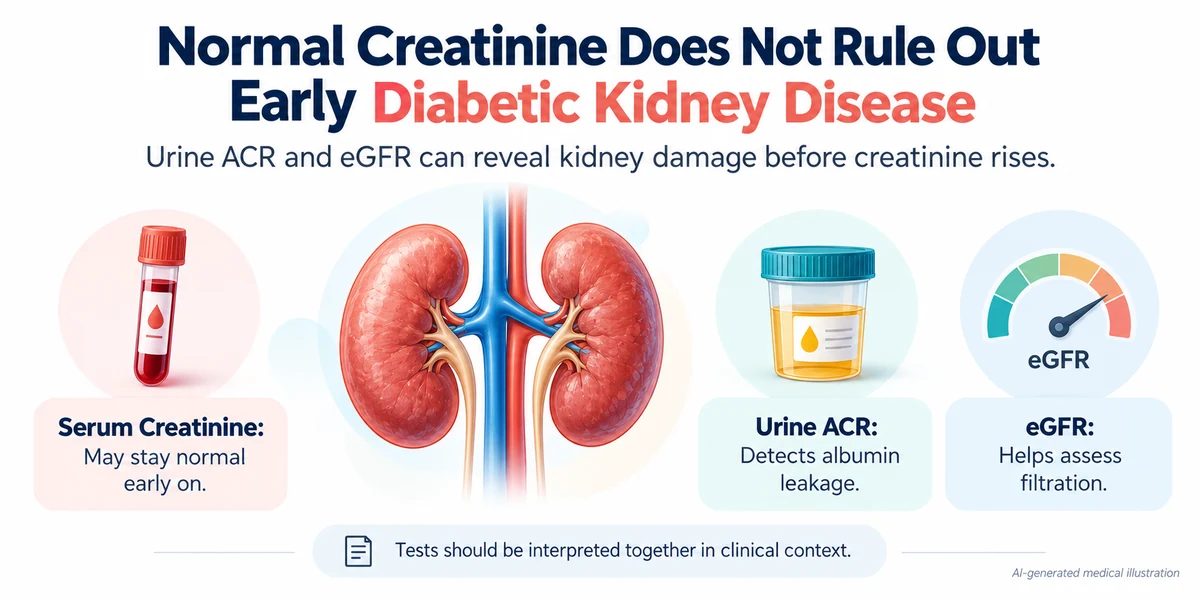
Each test answers a different question about kidney health. Understanding their roles helps catch disease early.
Test | What it measures | Why it matters |
|---|---|---|
Serum Creatinine | Creatinine concentration in blood | Helps assess kidney filtration |
eGFR | Estimated kidney filtration, commonly calculated using creatinine, age and sex | Helps identify reduced kidney function |
Urine ACR | Albumin relative to creatinine in urine | Helps identify |
Because they assess different aspects, clinicians interpret them together rather than in isolation.
An eGFR of 90 mL/min/1.73 m² or above does not independently confirm that the kidneys are healthy.
Persistently increased urine ACR may indicate kidney damage even when eGFR is relatively preserved.
However, an increased urine ACR result does not automatically establish that diabetes is the underlying cause. Repeat testing and clinical interpretation may be necessary.
Guidelines from the American Diabetes Association and KDIGO recommend:
Regular monitoring helps detect changes before symptoms appear.
Early diabetic kidney disease usually has no noticeable symptoms. When it progresses, patients may notice:
Transient factors can raise urine albumin, including intense exercise, fever, urinary‑tract infection, marked hyperglycaemia, menstruation, heart failure, or a sudden spike in blood pressure. One abnormal ACR result does not automatically confirm chronic kidney disease;An elevated urine ACR can sometimes be temporary.
Possible contributing factors include fever, urinary tract infection, strenuous exercise, menstruation, markedly elevated blood glucose, significantly elevated blood pressure and certain acute illnesses.
A single abnormal urine ACR result does not automatically establish chronic kidney disease.
Repeat testing may be recommended to confirm persistent albuminuria. The timing depends on the clinical circumstances.
Chronic kidney disease generally requires evidence of kidney abnormalities persisting for at least three months.
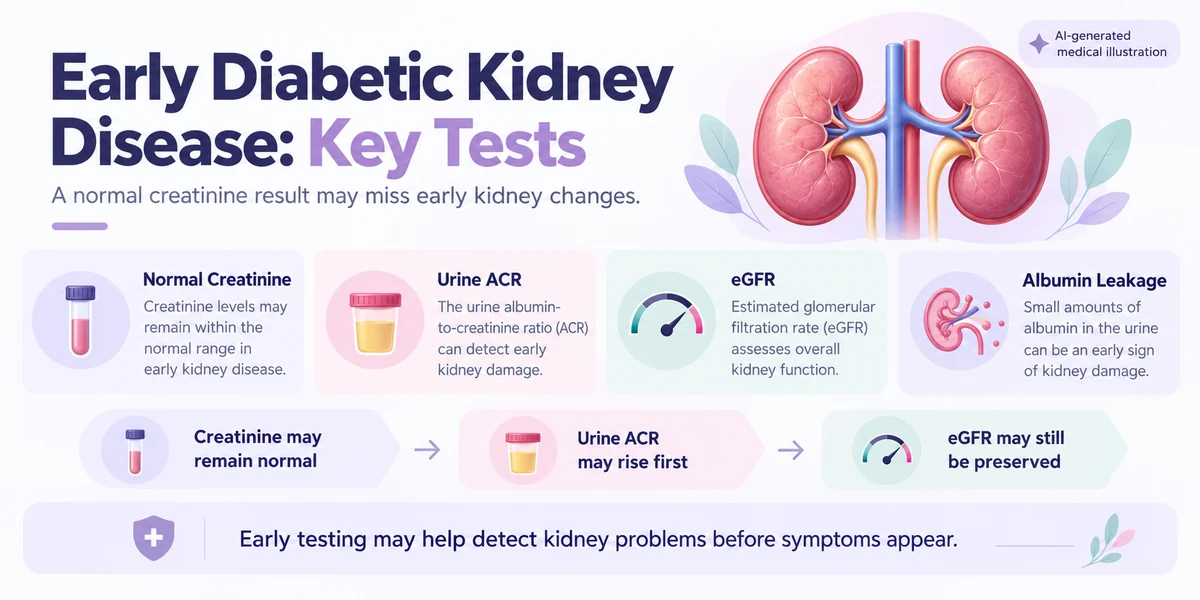
Look for patterns such as:
These patterns may indicate kidney abnormalities that require further evaluation.
However, they do not independently establish diabetic kidney disease.
The significance depends on repeat measurements, changes over time, other possible causes and the individual’s clinical condition.
Discuss the following with your clinician:
Nephrology evaluation may be appropriate when kidney test abnormalities are persistent, progressive, unexplained or associated with significant complications.
Possible reasons include:
Persistently elevated or rapidly increasing urine ACR.
Progressively declining eGFR.
Unexplained changes in serum creatinine.
Protein and blood detected together in urine.
Difficult-to-control blood pressure with kidney abnormalities.
Significant swelling associated with suspected kidney disease.
Abnormal electrolyte levels.
Uncertainty about the underlying cause of kidney dysfunction.
Suspected advanced chronic kidney disease.
Not everyone with mildly increased urine ACR requires immediate specialist referral.
The need for nephrology evaluation depends on the severity, persistence and overall clinical findings.
For related information, read Protein in Urine: Causes and Tests and Acute and Chronic Kidney Diseases.
Early diabetic kidney disease may develop without noticeable symptoms.
Urine ACR and eGFR testing can help identify kidney abnormalities before significant symptoms occur.
Appropriate blood glucose management, blood pressure control, selected medicines and regular monitoring may reduce the risk of kidney disease progression in eligible patients.
Certain medicines, including ACE inhibitors, ARBs and SGLT2 inhibitors, may provide kidney protection when prescribed for appropriate clinical indications.
However, these treatments are not suitable for everyone and may require monitoring for adverse effects.
Established chronic kidney damage may not be fully reversible, and no treatment guarantees complete recovery or prevention of kidney failure.
Individual treatment decisions should be based on clinical assessment.
Yes. Early diabetic kidney disease may cause albumin leakage in urine while serum creatinine remains within the laboratory reference range.
Yes. Persistent albuminuria or other markers of kidney damage may be present even when eGFR is relatively preserved.
Urine ACR and eGFR are important complementary tests. They help assess albumin leakage and kidney filtration.
Urine ACR can identify albumin leakage that creatinine alone may miss. However, both urine ACR and creatinine-based eGFR are important because they assess different aspects of kidney health.
Yes. Fever, urinary infection, strenuous exercise and other factors may temporarily increase urine albumin. Repeat testing may be needed.
Nephrology evaluation may be appropriate when urine albumin remains significantly elevated, kidney filtration declines, abnormal results change rapidly or the cause of kidney dysfunction is uncertain.
Diabetic kidney disease can develop even when serum creatinine remains within the normal laboratory range.
Urine ACR can help detect increased albumin leakage, while eGFR provides an estimate of kidney filtration.
Because these investigations measure different aspects of kidney health, they should be interpreted together.
Persistent albuminuria, declining kidney function or other concerning findings may require further evaluation.
Appropriate monitoring and individualised medical management may reduce the risk of kidney disease progression.
Clinical assessment remains important for determining the cause and significance of abnormal results.
Medical Information: Dr. Jyoti Bansode | MBBS, MD Medicine, DM Nephrology | Medical Registration No.: 2011/06/1863 | Maharashtra Medical Council (MMC).
Disclaimer: Website content and visuals are for general informational, educational and representational purposes only, may not reflect individual patient conditions or outcomes, and do not replace personalised medical advice, diagnosis or clinical assessment.
Plot no 70, Moreshwar Heritage, Sector 5, Ulwe, Navi Mumbai, Maharashtra 410206
For Booking: +91 8591009591
Chat With Us
Mini Sea Shore Road, Juhu Nagar, Sector 10A, Vashi, Navi Mumbai, Maharashtra 400703
Chat With Us