
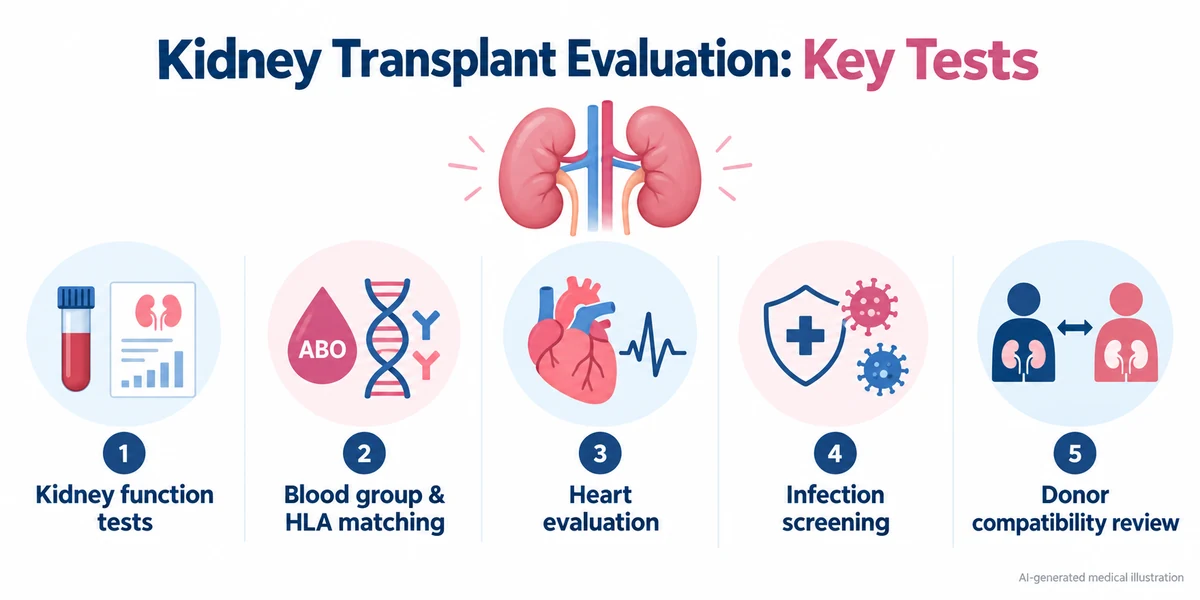
Kidney transplant evaluation is a detailed medical assessment used to determine whether a kidney transplant is an appropriate treatment for a person with advanced chronic kidney disease or kidney failure. The process involves reviewing kidney function, heart health, infections, donor compatibility and the person’s ability to manage long-term treatment.
Evaluation may begin before dialysis becomes necessary. Early discussion with a kidney specialist can provide time for medical investigations, donor assessment and treatment planning.
However, not everyone with advanced kidney disease is suitable for transplantation. The benefits, surgical risks and lifelong treatment requirements must be considered individually.
Kidney transplantation is a treatment for kidney failure, not a permanent cure.
– Evaluation may begin before dialysis is required.
– Eligibility depends on overall health, not eGFR alone.
– Blood tests, heart assessments, infection screening and other investigations may be needed.
– Living and deceased donor transplantation involve different preparation pathways.
– Donor compatibility and donor safety require separate assessment.
– Immunosuppressive medicines and regular follow-up are essential after transplantation.
– Evaluation does not guarantee approval, a donor match or successful transplantation.
A kidney transplant is a surgical procedure in which a healthy kidney from a living or deceased donor is placed into a person whose kidneys can no longer function adequately.
The transplanted kidney helps filter waste products and excess fluid from the bloodstream.
In most cases, the person’s original kidneys are left in place unless there is a specific medical reason to remove them.
The transplanted kidney is usually positioned in the lower abdomen, where its blood vessels and ureter are connected.
Kidney transplantation may provide better long-term outcomes than remaining on dialysis for many suitable patients, but it involves significant risks and lifelong medical care.
According to the National Institute of Diabetes and Digestive and Kidney Diseases (NIDDK), transplantation is a treatment for kidney failure rather than a cure.
Kidney transplant evaluation is a series of medical, surgical and psychosocial assessments performed by a transplant team.
The evaluation helps determine:
– Whether the person is medically suitable for major surgery.
Whether transplantation is likely to offer meaningful benefit.
Whether additional health conditions require treatment.
Whether a living or deceased donor pathway may be appropriate.
Whether donor compatibility testing is required.
Whether the person understands the need for lifelong medicines and follow-up.
The process may involve several visits over weeks or months. Additional investigations may be required depending on individual findings.
Transplantation can be discussed when chronic kidney disease becomes advanced or is expected to progress toward kidney failure.
Evaluation may be considered before dialysis starts, especially when kidney function is declining and transplantation could be a suitable future treatment.
A common approach is to discuss transplant referral during advanced CKD, often around stage 4, but the appropriate timing depends on the rate of kidney function decline and the person’s overall condition.
An eGFR value alone should not determine when evaluation begins.
Factors influencing timing include:
Current eGFR and its rate of decline.
Symptoms and complications of kidney disease.
Underlying cause of kidney failure.
Cardiovascular health.
Other medical conditions.
Availability of a potential living donor.
Expected time needed to complete evaluation.
People already receiving dialysis may also undergo transplant assessment.
For related information, read about Acute & Chronic Kidney Diseases.
People with advanced irreversible kidney disease or kidney failure may be considered for transplantation when the expected benefits outweigh the risks.
Possible candidates include:
People with advanced chronic kidney disease approaching kidney failure.
People receiving haemodialysis or peritoneal dialysis.
Selected patients who may undergo transplantation before dialysis begins.
People with kidney failure caused by diabetes, hypertension or certain other kidney conditions.
Patients with suitable medical and surgical risk profiles.
Age alone does not necessarily determine eligibility. Frailty, other health problems and functional status may be more important.
A transplant may be delayed or considered unsuitable when certain conditions significantly increase surgical or long-term treatment risks.
Examples include:
Active serious infection.
Certain active cancers.
Severe cardiovascular disease that cannot be adequately managed.
Major uncontrolled medical conditions.
Significant untreated health problems that affect procedural safety.
Circumstances that make essential post-transplant care difficult to maintain.
Some conditions are temporary barriers rather than permanent exclusions.
For example, a person with an active infection may become suitable after successful treatment.
Eligibility is determined by the transplant team following individual assessment.
The exact tests depend on age, medical history, previous investigations and transplant centre protocols.
Laboratory investigations may include:
Serum creatinine and eGFR.
Electrolytes, including potassium.
Complete blood count.
Liver function tests.
Blood glucose and HbA1c when indicated.
Albumin and nutritional assessments.
Blood-clotting tests when necessary.
These investigations help assess kidney failure, associated complications and general medical fitness.
Compatibility testing helps determine whether a donor kidney is suitable for the recipient.
Important tests may include:
ABO blood group: Helps assess blood group compatibility.
Human leukocyte antigen (HLA) typing: Evaluates tissue-matching characteristics.
HLA antibody testing: Identifies antibodies that may react against donor tissue.
Crossmatch testing: Assesses whether recipient antibodies react against a particular donor.
A suitable match does not eliminate the possibility of rejection.
In certain circumstances, specialised transplant programmes may consider transplantation between otherwise incompatible donor-recipient pairs, but this requires additional assessment and risk management.
Kidney transplant surgery places demands on the heart and circulatory system.
Depending on clinical risk, investigations may include:
Electrocardiogram (ECG).
Echocardiogram.
Assessment for coronary artery disease.
Cardiac stress testing when indicated.
Additional cardiovascular investigations when required.
Not every patient needs the same cardiac tests.
Transplant recipients require immunosuppressive treatment, which increases susceptibility to certain infections.
Screening may include:
Hepatitis B.
Hepatitis C.
HIV.
Tuberculosis.
Cytomegalovirus (CMV).
Other infections based on medical history and clinical risk.
An infection-related finding does not automatically exclude transplantation. Appropriate treatment, prevention or monitoring may make transplantation possible.
Cancer screening is performed according to age, medical history and risk factors.
Tests may include:
Breast screening.
Cervical screening.
Colorectal screening.
Prostate assessment when appropriate.
Skin examination.
Additional tests for people with specific risk factors.
Imaging may help evaluate blood vessels and other structures involved in transplant surgery.
Investigations may include:
Chest imaging.
Abdominal or pelvic imaging.
Vascular assessment.
Additional scans when indicated.
Transplant care requires ongoing medical appointments and strict adherence to prescribed medicines.
Assessment may explore:
Understanding of the transplant process.
Mental and emotional wellbeing.
Ability to manage daily medicines.
Availability of practical support when needed.
Transportation and follow-up arrangements.
Financial and other barriers to long-term care.
The purpose is to identify support needs and address barriers, not to assume that a health condition or social circumstance automatically excludes someone.
The National Kidney Foundation’s transplant evaluation guide provides further information about transplant testing and assessment.
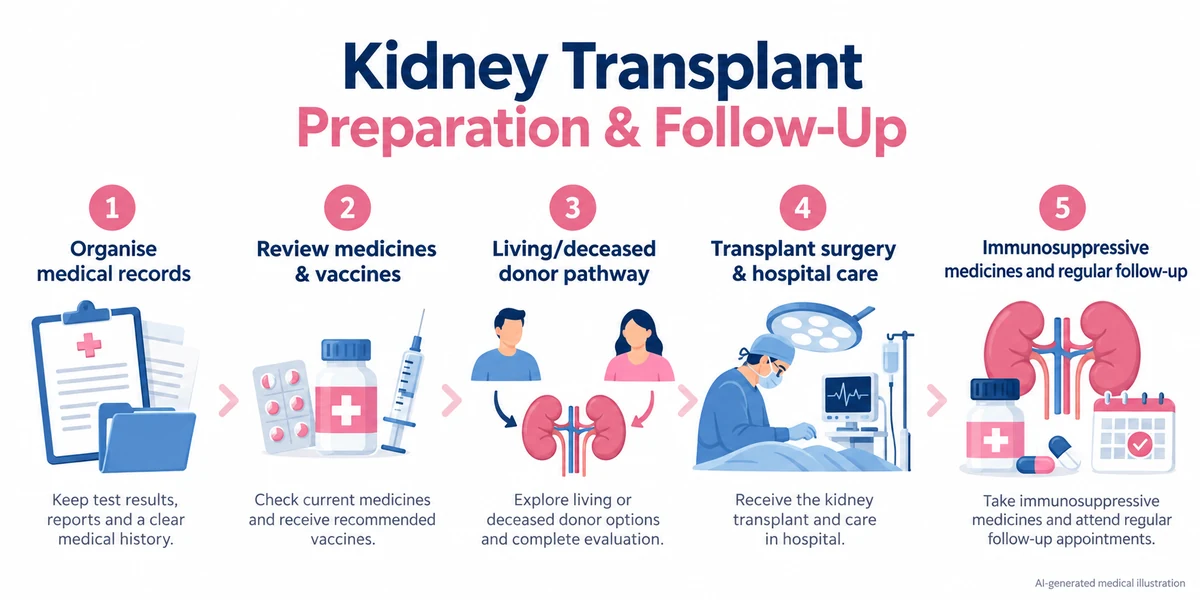
Preparation can help ensure that the transplant team has the information needed to complete an accurate assessment.
Useful documents may include:
– Previous kidney function results.
– Dialysis records, if applicable.
– Past hospital discharge summaries.
– Imaging reports.
– Previous surgery details.
– Vaccination history.
– Records of infections or other chronic conditions.
Include:
– Prescription medicines.
– Over-the-counter medicines.
– Blood pressure treatments.
– Diabetes medicines.
– Blood-thinning medicines.
– Herbal products.
– Vitamins and dietary supplements.
Do not stop or change medicines without the treating team’s advice.
Vaccination history is important because certain vaccines are best administered before transplantation.
The healthcare team may recommend vaccines based on medical history, immune status and current guidelines.
Some live vaccines may be unsuitable after immunosuppressive treatment begins.
Before transplantation, medical teams may work to improve:
– Blood pressure control.
– Diabetes management.
– Cardiovascular risk.
– Anaemia and nutritional problems.
– Active infections.
– Other relevant medical conditions.
Preparation may also involve:
– Understanding the evaluation schedule.
– Planning transportation.
– Identifying postoperative support.
– Discussing medicine costs and follow-up needs.
– Preparing questions about treatment options.
There are two main donor pathways.
| Feature | Living donor | Deceased donor |
|---|---|---|
| Donor | Living person who voluntarily donates a kidney | Person who has died and whose kidney is suitable for donation |
| Evaluation | Separate medical and ethical donor assessment | Organ suitability and recipient compatibility assessment |
| Timing | Surgery may be planned after approval | Timing depends on organ availability and allocation |
| Waiting period | Varies by donor assessment and availability | May involve a prolonged waiting period |
| Important consideration | Protecting donor safety and voluntary consent | Allocation rules, compatibility and available organs |
Both pathways require medical assessment.
Living donor evaluation is separate from recipient assessment.
Its primary purpose is to protect the donor’s health and determine whether donation is medically and ethically appropriate.
Tests may include:
– Medical and family history.
– Kidney function tests.
– Urine protein or albumin assessment.
– Blood pressure evaluation.
– Diabetes screening.
– Infection screening.
– Blood group and compatibility testing.
– Kidney imaging.
– Psychological and informed-consent assessment.
Potential donors should receive information about surgical risks, possible long-term effects and follow-up requirements.
Donation must be voluntary, and a potential donor may decide not to proceed.
For additional information, see the National Kidney Foundation’s Living Kidney Donor Evaluation guide.
A willing living donor may be incompatible with the intended recipient because of blood group differences or recipient antibodies.
Depending on medical circumstances and applicable transplant programme arrangements, options may include:
– Kidney paired donation or exchange.
– Additional compatibility assessment.
– Specialised protocols for selected incompatible transplants.
– Considering another donor pathway.
These options are not suitable or available in every case.
The transplant team must evaluate safety, clinical appropriateness and applicable legal requirements.
After investigations are completed, the transplant team reviews the results.
Possible outcomes include:
The person may be accepted as a transplant candidate, subject to applicable clinical and allocation requirements.
Some findings may require further investigation before a decision can be made.
Evaluation may be paused while an infection, cardiovascular problem or another health condition is treated.
In some cases, the anticipated risks may outweigh the benefits.
Other kidney replacement treatment options and supportive medical care may then be discussed.
Completing evaluation does not guarantee acceptance, donor availability or transplantation.
Some people may need dialysis while waiting for transplantation.
Others may be evaluated and prepared before dialysis is required.
During the waiting period, care may involve:
– Regular kidney function monitoring.
– Dialysis when clinically necessary.
– Blood pressure and diabetes management.
– Updating transplant investigations when required.
– Reporting new infections or medical conditions.
– Following the transplant team’s compatibility-testing schedule.
– Keeping communication and contact details current.
Waiting-list rules and organ allocation procedures vary according to the applicable healthcare system and regulatory framework.
Kidney transplantation is major surgery and carries both short-term and long-term risks.
Possible complications include:
– Bleeding.
– Infection.
– Blood clots.
– Urinary leakage or obstruction.
– Blood vessel complications.
– Delayed function of the transplanted kidney.
– Anaesthesia-related complications.
The immune system may recognise the donated kidney as foreign and attack it.
Rejection can occur even when donor compatibility testing has been completed.
Some episodes can be treated, but rejection may sometimes lead to permanent graft damage or failure.
Medicines used to prevent rejection may increase the risk of:
– Infection.
– Certain cancers.
– High blood pressure.
– Diabetes or worsening blood glucose.
– Medication-related kidney or metabolic complications.
The risks and benefits of each treatment must be assessed individually.
After transplantation, patients receive hospital care and monitoring.
The healthcare team may assess:
– Urine output.
– Serum creatinine.
– Electrolytes.
– Blood pressure.
– Fluid balance.
– Wound healing.
– Medicine levels when indicated.
Some transplanted kidneys begin functioning promptly, while others take longer to recover.
Temporary dialysis may be necessary if the transplanted kidney does not function adequately immediately after surgery.
A kidney transplant requires ongoing care for as long as the transplanted kidney is functioning.
Long-term management generally includes:
– Taking prescribed immunosuppressive medicines.
– Attending regular transplant follow-up appointments.
– Monitoring kidney function through blood and urine tests.
– Assessing blood pressure and glucose levels.
– Screening for infection and other complications.
– Reviewing medicine interactions and side effects.
– Following individualised lifestyle and dietary guidance.
Do not stop immunosuppressive medicines without explicit guidance from the transplant team. Missing or stopping these medicines can increase the risk of rejection.
People awaiting a transplant should seek medical advice for significant changes in their health, particularly infection or worsening kidney failure symptoms.
After transplantation, prompt transplant-team assessment is especially important for:
– Fever or chills.
– Reduced urine output.
– Increasing swelling.
– Pain near the transplant site.
– New urinary symptoms.
– Vomiting that prevents medicines from being taken.
– Unexplained deterioration in general health.
Seek emergency medical care for severe breathlessness, chest pain, confusion, fainting or rapidly worsening symptoms.
Not all rejection episodes cause symptoms, so routine blood tests remain important even when the person feels well.
Useful questions for the transplant team include:
– Am I medically suitable for transplantation?
– Should evaluation begin before dialysis?
– Which tests are needed in my case?
– What medical problems could delay transplantation?
– Is a living donor pathway appropriate?
– What risks should a potential donor understand?
– What happens if a donor is incompatible?
– Which medicines will be required after surgery?
– What are the risks of rejection and infection?
– How often will follow-up tests be needed?
– What happens if the transplanted kidney does not work as expected?
It is a medical assessment that helps determine whether a kidney transplant is a safe and appropriate treatment option.
Experts recommend starting the evaluation when the eGFR falls between 25 and 30 mL/min/1.73 m², allowing enough time to complete testing before reaching end‑stage renal disease.
The evaluation typically includes blood work for kidney function and HLA typing, imaging such as chest X‑ray and kidney ultrasound, cardiac screening, and a psychosocial interview.
Yes. Patients on dialysis are often evaluated concurrently so they can be listed immediately if they meet all medical and psychosocial criteria.
Most transplant centers provide a decision within 1–2 weeks after the one‑day assessment, though complex cases may require additional testing.
Fever can signal infection, which is a red‑flag for transplant candidates. Contact your nephrologist or transplant coordinator immediately.
Living donors undergo a parallel evaluation to ensure kidney health, blood type compatibility, and overall suitability, often completing the process faster than deceased‑donor pathways.
Kidney transplant evaluation is an important part of planning treatment for advanced chronic kidney disease and kidney failure.
The process assesses medical suitability, donor compatibility, surgical risks and the need for long-term treatment. It may begin before dialysis is required and often involves several investigations and appointments.
Early discussion, careful assessment and informed decision-making help patients understand whether transplantation is appropriate for their individual circumstances.
Kidney transplantation can offer substantial benefits to suitable patients, but it is not free from risk and does not eliminate the need for lifelong medical care.
Medical Information: Dr. Jyoti Bansode, MBBS, MD Medicine, DM Nephrology | Medical Registration No.: 2011/06/1863 | Maharashtra Medical Council (MMC).
Medical Review Status: Pending review and approval by Dr. Jyoti Bansode.
Disclaimer: Website content and visuals are for general informational, educational and representational purposes only, may not reflect individual patient conditions or outcomes, and do not replace personalised medical advice, diagnosis or clinical assessment.
Plot no 70, Moreshwar Heritage, Sector 5, Ulwe, Navi Mumbai, Maharashtra 410206
For Booking: +91 8591009591
Chat With Us
Mini Sea Shore Road, Juhu Nagar, Sector 10A, Vashi, Navi Mumbai, Maharashtra 400703
Chat With Us