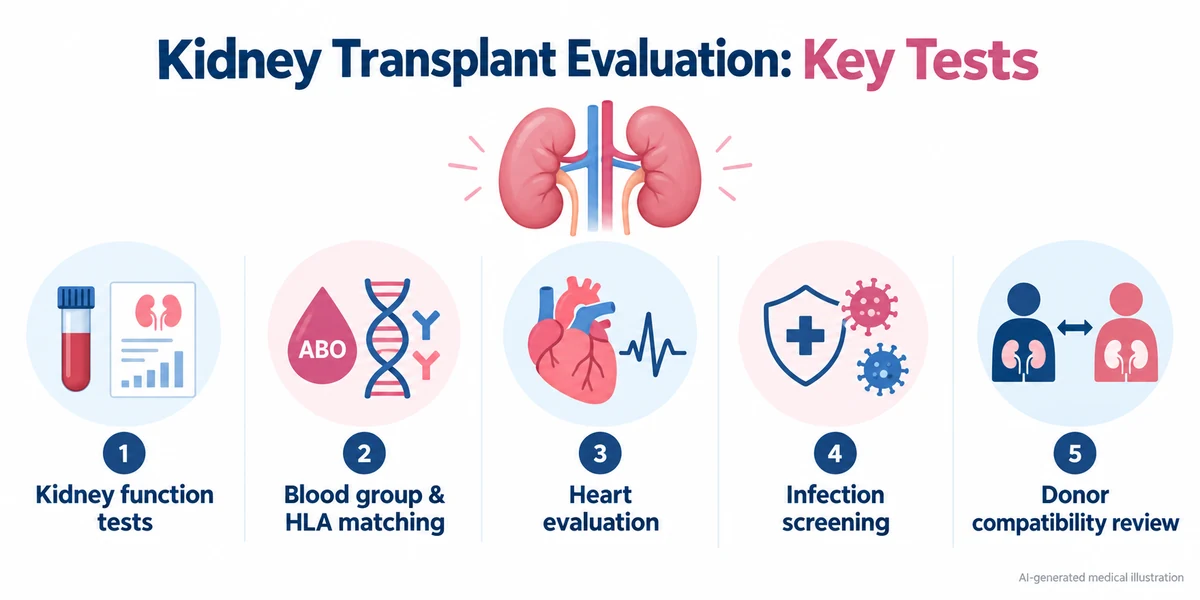
Kidney transplant evaluation is a detailed medical assessment used to determine whether a kidney transplant is an appropriate treatment for a person with advanced chronic kidney disease or kidney failure. The process involves reviewing kidney function, heart health, infections, donor compatibility and the person’s ability to manage long-term treatment. Evaluation may begin before dialysis becomes necessary. Early discussion with a kidney specialist can provide time for medical investigations, donor assessment and treatment planning. However, not everyone with advanced kidney disease is suitable for transplantation. The benefits, surgical risks and lifelong treatment requirements must be considered individually. Key Takeaways Kidney transplantation is a treatment for kidney failure, not a permanent cure. – Evaluation may begin before dialysis is required. – Eligibility depends on overall health, not eGFR alone. – Blood tests, heart assessments, infection screening and other investigations may be needed. – Living and deceased donor transplantation involve different preparation pathways. – Donor compatibility and donor safety require separate assessment. – Immunosuppressive medicines and regular follow-up are essential after transplantation. – Evaluation does not guarantee approval, a donor match or successful transplantation. What Is a Kidney Transplant? A kidney transplant is a surgical procedure in which a healthy kidney from a living or deceased donor is placed into a person whose kidneys can no longer function adequately. The transplanted kidney helps filter waste products and excess fluid from the bloodstream. In most cases, the person’s original kidneys are left in place unless there is a specific medical reason to remove them. The transplanted kidney is usually positioned in the lower abdomen, where its blood vessels and ureter are connected. Kidney transplantation may provide better long-term outcomes than remaining on dialysis for many suitable patients, but it involves significant risks and lifelong medical care. According to the National Institute of Diabetes and Digestive and Kidney Diseases (NIDDK), transplantation is a treatment for kidney failure rather than a cure. What Is Kidney Transplant Evaluation? Kidney transplant evaluation is a series of medical, surgical and psychosocial assessments performed by a transplant team. The evaluation helps determine: – Whether the person is medically suitable for major surgery. Whether transplantation is likely to offer meaningful benefit. Whether additional health conditions require treatment. Whether a living or deceased donor pathway may be appropriate. Whether donor compatibility testing is required. Whether the person understands the need for lifelong medicines and follow-up. The process may involve several visits over weeks or months. Additional investigations may be required depending on individual findings. When Should Kidney Transplant Evaluation Begin? Transplantation can be discussed when chronic kidney disease becomes advanced or is expected to progress toward kidney failure. Evaluation may be considered before dialysis starts, especially when kidney function is declining and transplantation could be a suitable future treatment. A common approach is to discuss transplant referral during advanced CKD, often around stage 4, but the appropriate timing depends on the rate of kidney function decline and the person’s overall condition. An eGFR value alone should not determine when evaluation begins. Factors influencing timing include: Current eGFR and its rate of decline. Symptoms and complications of kidney disease. Underlying cause of kidney failure. Cardiovascular health. Other medical conditions. Availability of a potential living donor. Expected time needed to complete evaluation. People already receiving dialysis may also undergo transplant assessment. For related information, read about Acute & Chronic Kidney Diseases. Who May Be Considered for a Kidney Transplant? People with advanced irreversible kidney disease or kidney failure may be considered for transplantation when the expected benefits outweigh the risks. Possible candidates include: People with advanced chronic kidney disease approaching kidney failure. People receiving haemodialysis or peritoneal dialysis. Selected patients who may undergo transplantation before dialysis begins. People with kidney failure caused by diabetes, hypertension or certain other kidney conditions. Patients with suitable medical and surgical risk profiles. Age alone does not necessarily determine eligibility. Frailty, other health problems and functional status may be more important. What Conditions May Affect Transplant Eligibility? A transplant may be delayed or considered unsuitable when certain conditions significantly increase surgical or long-term treatment risks. Examples include: Active serious infection. Certain active cancers. Severe cardiovascular disease that cannot be adequately managed. Major uncontrolled medical conditions. Significant untreated health problems that affect procedural safety. Circumstances that make essential post-transplant care difficult to maintain. Some conditions are temporary barriers rather than permanent exclusions. For example, a person with an active infection may become suitable after successful treatment. Eligibility is determined by the transplant team following individual assessment. What Tests Are Required During Kidney Transplant Evaluation? The exact tests depend on age, medical history, previous investigations and transplant centre protocols. 1. Kidney Function and General Blood Tests Laboratory investigations may include: Serum creatinine and eGFR. Electrolytes, including potassium. Complete blood count. Liver function tests. Blood glucose and HbA1c when indicated. Albumin and nutritional assessments. Blood-clotting tests when necessary. These investigations help assess kidney failure, associated complications and general medical fitness. 2. Blood Group and Tissue Matching Compatibility testing helps determine whether a donor kidney is suitable for the recipient. Important tests may include: ABO blood group: Helps assess blood group compatibility. Human leukocyte antigen (HLA) typing: Evaluates tissue-matching characteristics. HLA antibody testing: Identifies antibodies that may react against donor tissue. Crossmatch testing: Assesses whether recipient antibodies react against a particular donor. A suitable match does not eliminate the possibility of rejection. In certain circumstances, specialised transplant programmes may consider transplantation between otherwise incompatible donor-recipient pairs, but this requires additional assessment and risk management. 3. Cardiovascular Evaluation Kidney transplant surgery places demands on the heart and circulatory system. Depending on clinical risk, investigations may include: Electrocardiogram (ECG). Echocardiogram. Assessment for coronary artery disease. Cardiac stress testing when indicated. Additional cardiovascular investigations when required. Not every patient needs the same cardiac tests. 4. Infection Screening Transplant recipients require immunosuppressive treatment, which increases susceptibility to certain infections. Screening may include: Hepatitis B. Hepatitis C. HIV. Tuberculosis. Cytomegalovirus (CMV). Other infections based on medical history and clinical risk. An infection-related finding does not automatically exclude