
Short answer : Protein in urine can be a fleeting finding after fever, intense exercise, or dehydration, but persistent proteinuria often signals damage to the kidney’s filtering units (glomeruli). Ongoing leakage may require further testing and specialist care.
Proteinuria—often discovered on a routine urine test—doesn’t always mean serious disease. A single abnormal result may be temporary, yet repeated or high‑level protein loss usually points to kidney‑filter damage that needs evaluation.
Healthy kidneys keep large proteins such as albumin inside the bloodstream while allowing waste and excess fluid to pass into urine. The glomeruli act as tiny sieves; when they are inflamed, scarred, or otherwise damaged, proteins slip through and appear in the urine.
When the glomerular barrier is compromised, albumin and other proteins are lost, leading to a measurable proteinuria.
These conditions often produce ongoing protein leakage and merit a thorough work‑up:
For an in‑depth look at these factors, see Causes of Protein in Urine: Understanding the Key Factors.
Not every positive protein test signals chronic disease. Transient proteinuria often resolves once the trigger disappears:
Because a single abnormal result may be fleeting, clinicians often repeat a morning urine sample before ordering extensive work‑up.

Early proteinuria is frequently silent, but watch for these clues:
Most people with mild proteinuria feel fine; the presence of symptoms often indicates a higher level of protein loss or concurrent kidney dysfunction.
No. Foam can result from rapid urine flow, concentrated urine, or even certain detergents in the toilet bowl. Only a laboratory test (dipstick or ACR) can confirm proteinuria.
Proteinuria (protein) and hematuria (blood) are distinct findings. Protein indicates a leak of albumin or larger proteins, while blood signals red‑cell leakage, often from a different part of the urinary tract. When both appear together, clinicians consider glomerular disease or severe inflammation.
Read more about the overlap in our protein and blood in urine article.
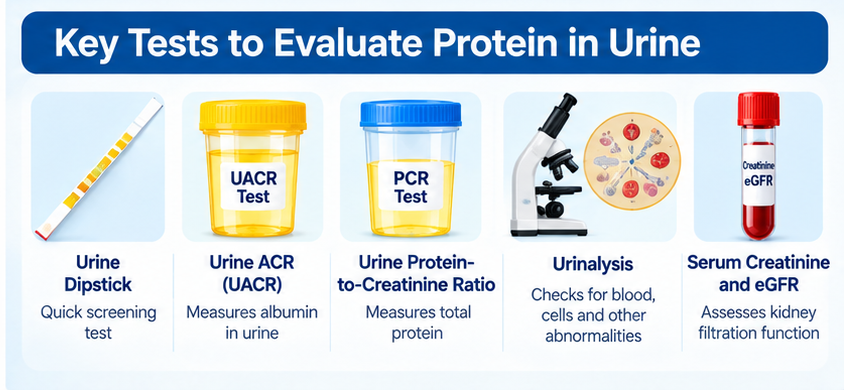
The most common tests include:
Interpretation of UACR:
Range (mg/g)Interpretation<30Normal or low‑grade30–300Micro‑albuminuria (early kidney damage)>300Macro‑albuminuria (significant kidney disease)
| UACR Result | Interpretation |
|---|---|
| Below 30 mg/g | Normal to mildly increased |
| 30–300 mg/g | Moderately increased albuminuria |
| Above 300 mg/g | Severely increased albuminuria |
Results should be repeated, especially if the first sample was a random collection, and interpreted alongside creatinine, eGFR, and clinical context.
Yes. Protein leakage can precede a rise in serum creatinine because creatinine reflects overall filtration, not the selective loss of albumin. Early glomerular injury may show a high UACR while eGFR remains >90 mL/min/1.73 m².
Persistent, significant proteinuria—especially when accompanied by any of the following—should raise suspicion for a primary glomerular disorder:
Dr. Jyoti Bansode has a special clinical interest in glomerular diseases; patients with these red flags are often referred for nephrology evaluation.
Most proteinuria cases are managed without invasive procedures. A biopsy is considered when:
Read more about the procedure in our kidney biopsy overview.
Consider specialist care if you have any of the following:
Schedule a consultation through our appointment and consultation page.
Protein in urine can result from diabetes, hypertension, glomerular diseases, infections, certain medications, or temporary factors such as fever, intense exercise, and dehydration.
Yes. Dehydration concentrates urine, which can make a dipstick appear falsely positive for protein, but repeat testing after rehydration usually normalizes the result.
No. Foam may be caused by rapid urine flow, concentrated urine, or detergents. Only a laboratory urine protein test can confirm true proteinuria.
Absolutely. Transient proteinuria occurs with fever, strenuous exercise, acute illness, or dehydration and often resolves without treatment.
Yes. Early kidney damage can leak protein while serum creatinine and eGFR remain within normal limits, so protein tests catch problems before creatinine rises.
An ACR below 30 mg/g is normal. Values between 30–300 mg/g indicate micro‑albuminuria, and above 300 mg/g suggest macro‑albuminuria, which warrants further evaluation.
If you notice foamy urine, swelling, or have risk factors like diabetes or high blood pressure, ask your doctor for a urine protein test. Early detection and appropriate follow‑up can protect kidney health.
Plot no 70, Moreshwar Heritage, Sector 5, Ulwe, Navi Mumbai, Maharashtra 410206
For Booking: +91 8591009591
Chat With Us
Mini Sea Shore Road, Juhu Nagar, Sector 10A, Vashi, Navi Mumbai, Maharashtra 400703
Chat With Us