
Diabetic kidney disease (DKD) is a form of kidney damage associated with diabetes. Over time, high blood glucose can affect the kidneys’ filtering structures, sometimes causing albumin to leak into urine or reducing kidney filtration.
Early diabetic kidney disease often develops without noticeable symptoms. Urine albumin-to-creatinine ratio (uACR) and estimated glomerular filtration rate (eGFR) tests help identify and monitor kidney abnormalities.
Not everyone with diabetes develops kidney disease. Individual risk depends on diabetes duration, blood glucose management, blood pressure and other medical factors.
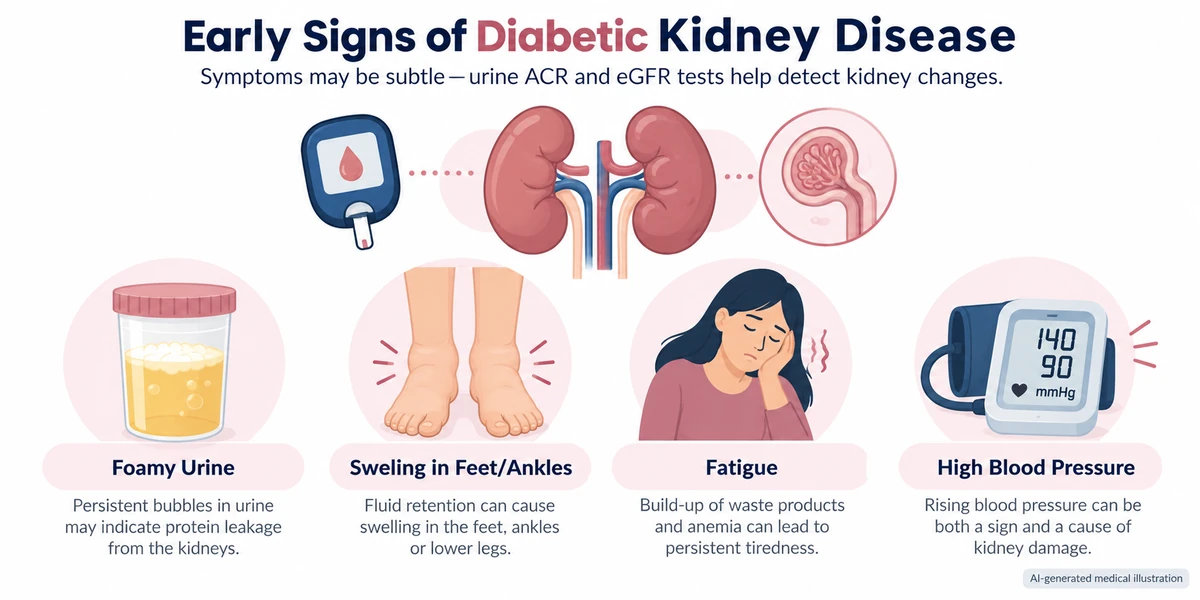
Early diabetic kidney disease often causes no obvious symptoms. The first signs may appear on kidney tests, such as increased albumin in urine or changes in eGFR.
As kidney disease progresses, possible symptoms may include:
Because early diabetic kidney disease is often silent, blood and urine tests are more reliable than waiting for symptoms to appear.
Diabetic kidney disease develops when diabetes damages the small blood vessels and filtering structures inside the kidneys.
The kidneys contain microscopic filtering units called glomeruli. Over time, persistently high blood glucose can damage these filters, allowing albumin to leak into the urine and gradually reducing the kidneys’ ability to remove waste from the blood.
High blood pressure can further increase stress on the kidneys and accelerate kidney damage.
For a broader explanation, read about diabetes and kidney diseases.
Kidneys have significant reserve capacity. Early kidney damage may therefore develop while a person still feels completely well.
NIDDK notes that most people with diabetic kidney disease do not have symptoms in the early stages. Kidney problems are usually detected through blood and urine tests.
A patient can have:
No pain + no swelling + normal-looking urine
and still have albuminuria or another early kidney abnormality.
Not everyone with diabetes develops diabetic kidney disease.
Risk may be greater in people who have:
NIDDK identifies poor blood-glucose control and high blood pressure as especially important risk factors.
Current ADA 2026 recommendations advise checking urine ACR and eGFR at least annually once a person has had type 1 diabetes for five years or more.
People with type 2 diabetes should generally have urine ACR and eGFR checked at least once a year from diagnosis, regardless of treatment. Diabetes Journals
This difference matters because type 2 diabetes may have been present for years before it is diagnosed.
Albumin is a protein that normally remains in the bloodstream.
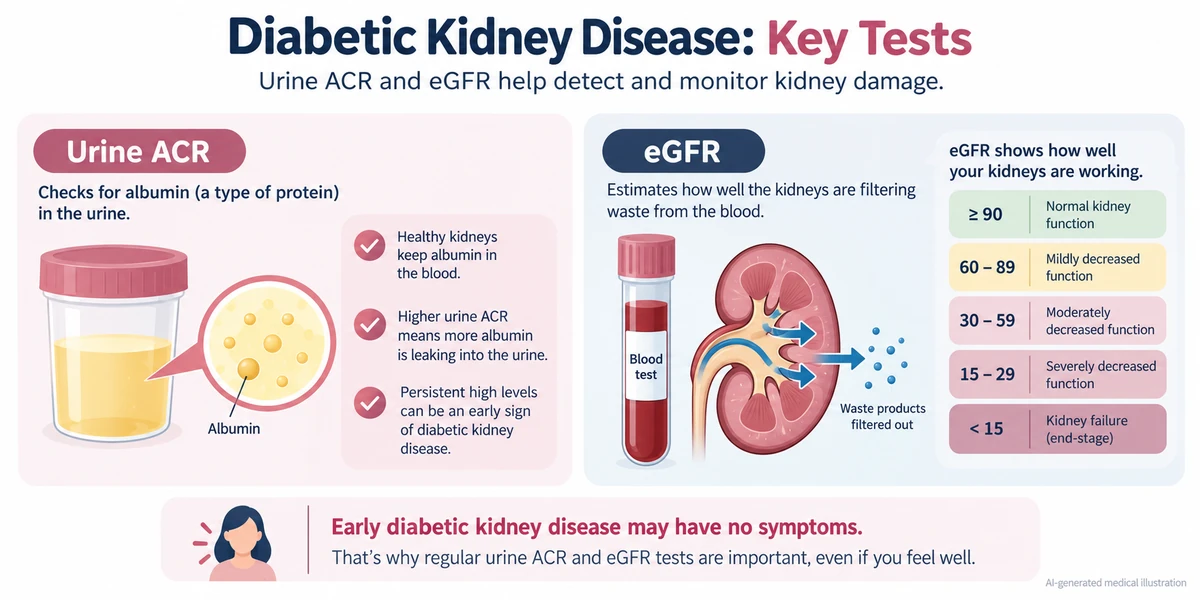
When the kidney filters are damaged, albumin can begin leaking into urine. This is called albuminuria.
The standard test used to measure this is the urine albumin-to-creatinine ratio (UACR).
For more detail, see the Urine ACR Test Guide.
The estimated glomerular filtration rate (eGFR) estimates how well the kidneys are filtering blood.
A declining eGFR can indicate reduced kidney function.
Creatinine is a waste product normally filtered from the blood by the kidneys.
As filtration worsens, serum creatinine may increase. However, creatinine alone is not enough to assess early diabetic kidney disease.
High blood pressure can damage kidney blood vessels, while kidney disease can also make blood pressure more difficult to control.
Patients with persistent blood-pressure problems can read more about resistant hypertension.
The two key kidney markers are:
NIDDK specifically identifies urine albumin and eGFR as the two major markers used to detect and monitor chronic kidney disease.
UACR measures albumin in urine relative to creatinine.
A random spot urine sample is usually sufficient, meaning a 24-hour urine collection is generally unnecessary for routine screening.
Typical categories include:
An increased urine ACR may indicate kidney damage, but one abnormal result does not automatically establish chronic kidney disease.
Albumin levels can be temporarily affected by fever, infection, strenuous exercise, menstruation, markedly elevated blood glucose and other factors.
Repeat testing and clinical assessment may be required to determine whether albuminuria is persistent.
eGFR estimates kidney filtration.
In general:
The result should always be interpreted alongside urine albumin and the patient’s medical history.
Yes.
A person may have:
Normal or relatively preserved eGFR + elevated urine ACR
and still have evidence of kidney damage.
Albuminuria can appear before significant changes in eGFR. This is why checking only creatinine or eGFR may miss early kidney damage.
| UACR | eGFR | What It May Suggest |
|---|---|---|
| Normal | Normal | Current kidney markers may be reassuring. |
| High | Normal | Possible early kidney damage. |
| Normal | Low | Reduced kidney filtration requiring evaluation. |
| High | Low | Kidney damage with reduced filtration may be present. |
Learn more about combined kidney testing in Kidney Tests Explained.
Yes.
A single elevated urine ACR does not always mean permanent kidney damage.
Factors that can temporarily raise UACR include:
Because UACR can vary, repeat testing and tracking trends over time are important.
Chronic kidney disease is based on persistent kidney abnormalities, not simply one isolated laboratory result.
Doctors may repeat an abnormal UACR and compare it with:
This reduces the risk of incorrectly labelling a temporary abnormality as chronic kidney disease.
Depending on the patient’s condition, kidney evaluation may include:
Used to calculate eGFR.
Can detect:
Provides additional information about kidney function and hydration.
These may include:
HbA1c shows average blood glucose over approximately the previous three months.
Blood-pressure monitoring is especially important because hypertension can accelerate kidney damage.
NIDDK includes urinalysis, UACR, creatinine with eGFR, BUN and electrolytes among commonly used investigations when kidney disease is being evaluated.
No.
Diabetes is a common cause of chronic kidney disease, but a person with diabetes may also develop an unrelated kidney condition.
Doctors may look for another cause when there is:
NIDDK specifically advises clinicians not to automatically assume that all CKD in people with diabetes is diabetic kidney disease.
Diabetes, High Blood Pressure and Kidney Damage
Diabetes and hypertension can reinforce each other.
A simplified cycle looks like this:
High blood glucose → kidney filter damage → albumin leakage
High blood pressure → additional stress on kidney blood vessels
Kidney damage → blood pressure may become harder to control
Managing both blood glucose and blood pressure is therefore an important part of kidney protection.
In many patients, progression can be slowed by identifying kidney damage early and managing the factors contributing to it.
A kidney-protection plan may include:
NIDDK identifies blood-glucose and blood-pressure management as key approaches to helping prevent or slow diabetic kidney disease.
ACE inhibitors, ARBs and SGLT2 inhibitors are used according to individual clinical indications.
Depending on the medicine, potential risks may include low blood pressure, changes in kidney function, electrolyte abnormalities, volume depletion or other adverse effects.
Kidney function and electrolytes may require monitoring during treatment.
Patients should not start, stop or change prescribed medicines without guidance from their treating healthcare professional.
Appropriate blood glucose management, blood pressure control, selected medicines and kidney function monitoring may reduce the risk of diabetic kidney disease progression in eligible patients.
However, established chronic kidney damage may not be fully reversible. Treatment outcomes vary, and no medical treatment can guarantee complete recovery or prevention of kidney failure.
Current ADA guidance recommends:
Patients with changing kidney function may need more frequent monitoring.
Keep track of:
Useful questions to ask your doctor include:
For more information about urine albumin in diabetes, read the microalbuminuria in diabetes guide.
Nephrology evaluation may be appropriate when kidney abnormalities are persistent or progressive.
Reasons can include:
Current ADA guidance particularly recommends specialist evaluation when kidney disease progresses, the diagnosis is uncertain, management becomes difficult, or eGFR is severely reduced.
Individual kidney test results should be interpreted by a qualified healthcare professional.
Further evaluation may be appropriate when urine albumin levels remain elevated, kidney filtration declines or the underlying cause of kidney abnormalities is uncertain.
Investigation and treatment decisions depend on the patient’s clinical condition.
People with diabetes and kidney disease may require prompt medical evaluation when new or rapidly worsening symptoms occur.
Seek immediate emergency care for:
– Severe breathlessness.
– Chest pain.
– Confusion or loss of consciousness.
– Seizures.
– Very little or no urine output accompanied by significant illness.
– Rapidly worsening swelling with breathing difficulty.
Persistent vomiting, significant new swelling or unexpected deterioration in kidney function also requires timely medical assessment.
These symptoms may have several causes and should not automatically be attributed to diabetic kidney disease.
An eGFR below 60 mL/min/1.73 m² that persists for at least three months meets one criterion for chronic kidney disease.
An eGFR of 60 or above does not establish CKD without other evidence of kidney damage.
A single abnormal eGFR result may require repeat testing to distinguish acute changes from chronic kidney disease.
Early diabetic kidney disease often has no symptoms. Increased urine albumin or changes in eGFR may be among the first detectable abnormalities.
Urine ACR and eGFR are important complementary tests. Additional investigations depend on clinical findings.
Yes. Albuminuria or other kidney abnormalities may be present even when serum creatinine remains within the laboratory reference range.
Yes. Increased urine albumin may indicate kidney damage even when eGFR is relatively preserved.
Yes. Fever, infection, strenuous exercise and other factors can temporarily affect urine albumin measurements. Repeat testing may be needed.
Some abnormalities may improve with treatment, but established chronic kidney damage is often not fully reversible.
Diabetic kidney disease can develop without noticeable symptoms. Urine ACR and eGFR tests help detect kidney abnormalities and monitor changes over time.Appropriate diabetes management, blood pressure control and selected medical treatments may reduce the risk of kidney disease progression in some patients.Individual investigation and treatment decisions depend on medical history, laboratory findings and clinical assessment.
Disclaimer: Website content and visuals are for general informational, educational and representational purposes only, may not reflect individual patient conditions or outcomes, and do not replace personalised medical advice, diagnosis or clinical assessment.
Plot no 70, Moreshwar Heritage, Sector 5, Ulwe, Navi Mumbai, Maharashtra 410206
For Booking: +91 8591009591
Chat With Us
Mini Sea Shore Road, Juhu Nagar, Sector 10A, Vashi, Navi Mumbai, Maharashtra 400703
Chat With Us