
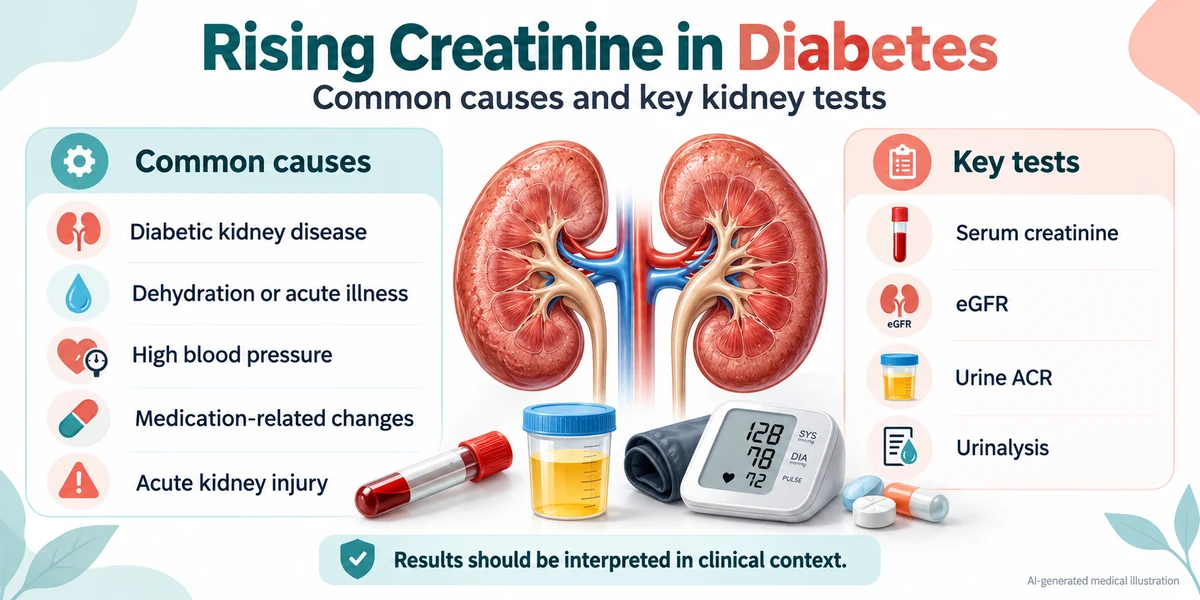
Rising creatinine in a person with diabetes may indicate a change in kidney filtration, but it does not automatically mean permanent kidney damage or kidney failure. Possible causes include acute kidney injury, dehydration, long-term diabetic kidney disease, high blood pressure, urinary obstruction and certain medication effects.
Serum creatinine is a waste product measured in blood. Its concentration is influenced by kidney function as well as muscle mass, diet and other factors.
An unexpected increase should be interpreted alongside previous creatinine results, estimated glomerular filtration rate (eGFR), urine albumin-to-creatinine ratio (uACR), medical history and symptoms.
The size and speed of the creatinine change can be more important than one isolated value.
This article explains why creatinine may rise in diabetes, how kidney tests are interpreted, which conditions require assessment and what symptoms should prompt urgent medical care.
Creatinine is a waste product produced through normal muscle metabolism.
The kidneys remove creatinine from the bloodstream, primarily through filtration, and it is then excreted in urine.
Serum creatinine testing helps assess kidney function, but it does not directly measure the amount of kidney damage.
Its interpretation depends on factors including:
– Age and body composition.
– Muscle mass.
– Recent strenuous exercise.
– Recent meat consumption.
– Certain medicines and supplements.
– Kidney filtration.
– Changes in hydration and circulation.
A creatinine result within the laboratory reference range does not always exclude kidney disease.
Similarly, an elevated result does not independently establish the cause or permanence of kidney dysfunction.
Diabetes may affect the kidneys’ small blood vessels and filtering structures over time.
Within each kidney, microscopic structures called glomeruli help filter blood while retaining most essential proteins.
Persistently elevated blood glucose can contribute to structural and functional changes in these filtering units.
Possible consequences include:
– Increased urinary albumin.
– Changes in glomerular filtration.
– Gradual reduction in eGFR.
– Increased kidney-related and cardiovascular risk.
– Development of chronic kidney disease in some individuals.
This condition is commonly described as diabetic kidney disease.
However, not every person with diabetes develops kidney disease.
Importantly, not every rise in creatinine in someone with diabetes is caused by diabetic kidney disease.
Read more about Diabetic Kidney Disease Symptoms.
A rising creatinine level can have several possible explanations.
Long-term diabetes may contribute to kidney damage and declining filtration.
In some individuals, urine albumin increases before eGFR declines.
Others experience reduced kidney filtration without significantly increased albuminuria.
Diabetic kidney disease often develops gradually, but changes in kidney function should not automatically be attributed to diabetes without considering other causes.
Fluid loss from vomiting, diarrhoea, fever or other causes may reduce blood flow to the kidneys.
Significant dehydration can contribute to acute kidney injury and increased serum creatinine.
People with markedly elevated blood glucose may lose additional fluid through increased urination.
However, drinking large amounts of water is not an appropriate treatment for every cause of high creatinine.
Fluid management depends on the underlying medical condition.
Acute kidney injury (AKI) involves a relatively sudden deterioration in kidney function.
Possible triggers include:
– Severe infection or sepsis.
– Significant dehydration.
– Reduced blood pressure or circulation.
– Certain medicines.
– Urinary tract obstruction.
– Other acute medical conditions.
AKI may develop in someone who previously had normal kidney function or in someone with established CKD.
An abrupt rise in creatinine warrants timely medical assessment.
Persistently elevated blood pressure can contribute to kidney blood vessel injury.
Diabetes and hypertension may occur together, increasing the importance of kidney and cardiovascular risk assessment.
Kidney dysfunction can also make blood pressure more difficult to manage.
Certain medicines may affect serum creatinine or kidney function.
Examples include:
– Non-steroidal anti-inflammatory drugs (NSAIDs).
– Some antibiotics and other medicines with potential kidney toxicity.
– Medicines that affect kidney blood flow.
– Certain medicines that alter creatinine secretion without necessarily reducing filtration.
ACE inhibitors and angiotensin receptor blockers (ARBs) may cause a modest creatinine rise after initiation because they change pressure within the glomeruli.
This does not automatically mean the medicine is causing harmful kidney injury.
Such treatments may provide kidney benefits in eligible patients.
The significance of a creatinine change depends on its magnitude, timing, potassium level, fluid status and other clinical findings.
Never stop or change prescribed medicines independently because of a creatinine result.
A blockage affecting urine drainage can impair kidney function.
Possible causes include:
– Certain urinary stones.
– Prostate enlargement.
– Urinary tract narrowing.
– Other structural conditions.
Additional investigations, including ultrasound, may be appropriate when obstruction is suspected.
Recent intense exercise, muscle injury, cooked meat consumption or creatine supplements may influence serum creatinine.
These factors do not always indicate kidney damage.
However, severe muscle injury can itself cause acute kidney injury, so symptoms and associated findings remain important.
No.
An increase in creatinine may indicate reduced filtration, but it does not automatically mean kidney failure.
Creatinine may increase because of temporary conditions, acute kidney injury, chronic kidney disease or non-kidney factors.
Kidney failure is assessed using kidney function, symptoms, complications and other findings.
One creatinine number alone cannot establish whether dialysis is needed.
Yes.
The timing of a change provides important diagnostic information.
| Feature | Sudden Creatinine Rise | Gradual Creatinine Rise |
|---|---|---|
| Pattern | Develops over hours or days. | Develops over months or years. |
| Possible Causes | Acute kidney injury (AKI), severe illness, dehydration, obstruction or medicine-related changes. | CKD progression or other longer-term conditions. |
| Importance of Previous Tests | Helps identify an acute change. | Helps determine trends and chronicity. |
| Evaluation | May require urgent assessment. | Depends on rate of progression and associated findings. |
| Possible Outcome | May improve if a reversible cause is treated. | Depends on underlying disease and response to management. |
Important: This table is a general guide rather than a diagnostic rule.
Acute kidney injury may occur on top of chronic kidney disease, and chronic disease does not always progress steadily.
What Creatinine Level Is Dangerous in Diabetes?
There is no single serum creatinine value that defines danger for every person.
For example, a new increase from 0.8 to 1.4 mg/dL over a short period may be clinically important even though the second number is below 2 mg/dL.
Conversely, a person with known stable chronic kidney disease may have a higher baseline creatinine that is being monitored through an established treatment plan.
The clinical significance depends on:
– Previous creatinine values.
– Speed of increase.
– eGFR and its trend.
– Potassium and other electrolyte results.
– Urine output.
– Blood pressure and fluid balance.
– Symptoms and associated illness.
In acute kidney injury assessment, established diagnostic criteria include an increase in serum creatinine of at least 0.3 mg/dL within 48 hours, or at least 1.5 times the known or presumed baseline within seven days.
These criteria are not interchangeable with a creatinine rise occurring over several weeks.
Do not wait for creatinine to exceed a specific number if severe symptoms or a rapid deterioration occurs.
Mild or early kidney dysfunction may cause no noticeable symptoms.
When kidney dysfunction is more significant, some people experience:
Swelling in the feet, ankles or around the eyes may occur with fluid retention or substantial urinary protein loss.
It can also have other causes.
Passing much less urine than usual may occur with acute kidney injury or other medical conditions.
However, some kidney problems develop without a noticeable reduction in urine volume.
Tiredness may accompany kidney dysfunction, anaemia or other conditions.
It is not specific to high creatinine.
These symptoms may occur in advanced kidney dysfunction but have many possible causes.
Breathing difficulty may occur with fluid overload or other serious conditions and requires prompt evaluation.
Symptoms alone cannot determine creatinine levels or the underlying diagnosis.
Evaluation may involve blood tests, urine investigations and selected imaging.
| Test | What it evaluates | Why it may help |
|---|---|---|
| Serum creatinine | Creatinine concentration in blood | Identifies changes from previous measurements |
| eGFR | Estimated kidney filtration | Helps assess filtration when kidney function is relatively stable |
| Urine ACR | Albumin relative to urine creatinine | Helps identify albumin leakage |
| Urinalysis | Blood, protein and other urine findings | May identify additional abnormalities |
| Potassium | Blood potassium concentration | Helps detect important electrolyte disturbances |
| Bicarbonate | Acid–base balance | May identify metabolic complications |
| HbA1c | Longer-term blood glucose | Supports diabetes management |
| Blood pressure | Arterial pressure | Helps evaluate hypertension and circulation |
| Kidney ultrasound | Structural findings | May help investigate obstruction or anatomical abnormalities |
Not every patient requires all investigations.
Most creatinine-based eGFR equations assume that serum creatinine is relatively stable.
During rapidly developing acute kidney injury, that assumption may not hold.
Therefore, a reported eGFR may not accurately represent current filtration while creatinine is changing quickly.
Clinical assessment and serial measurements are especially important in this situation.
For more information, see Kidney Tests Explained.
When chronic kidney disease is being evaluated, the following eGFR categories are commonly used.
| eGFR (mL/min/1.73 m²) | Category | Description |
|---|---|---|
| 90 or above | G1 | Normal or high |
| 60–89 | G2 | Mildly decreased |
| 45–59 | G3a | Mildly to moderately decreased |
| 30–44 | G3b | Moderately to severely decreased |
| 15–29 | G4 | Severely decreased |
| Below 15 | G5 | Kidney failure range |
G1 and G2 alone do not establish CKD without other persistent markers of kidney damage.
CKD generally involves kidney abnormalities lasting at least three months.
One low eGFR result during acute illness should not automatically be labelled chronic kidney disease.
Serum creatinine and urine ACR assess different aspects of kidney health.
Serum creatinine and eGFR: Provide information about kidney filtration.
Urine ACR: Helps detect increased albumin leakage.
Some people with diabetes have persistent urine albumin abnormalities while serum creatinine remains within the laboratory reference range.
Others have reduced filtration without increased albuminuria.
Therefore, both tests are useful during kidney risk assessment.
| Urine ACR (mg/g) | Category | Interpretation |
|---|---|---|
| Below 30 | A1 | Normal to mildly increased |
| 30–299 | A2 | Moderately increased albuminuria |
| 300 or above | A3 | Severely increased albuminuria |
An abnormal result may require confirmation.
Fever, infection, strenuous exercise and other medical factors can temporarily influence urinary albumin.
Persistent albuminuria does not independently identify the underlying kidney disease.
Read Urine ACR Test Explained for further details.
Yes.
Some people develop reduced kidney function without substantial albuminuria.
Possible causes include:
– Certain forms of diabetic kidney disease.
– Acute kidney injury.
– Urinary obstruction.
– Tubulointerstitial kidney conditions.
– Other medical disorders.
A normal urine ACR does not exclude every cause of kidney dysfunction.
Similarly, an elevated urine ACR does not prove that diabetes is the cause.
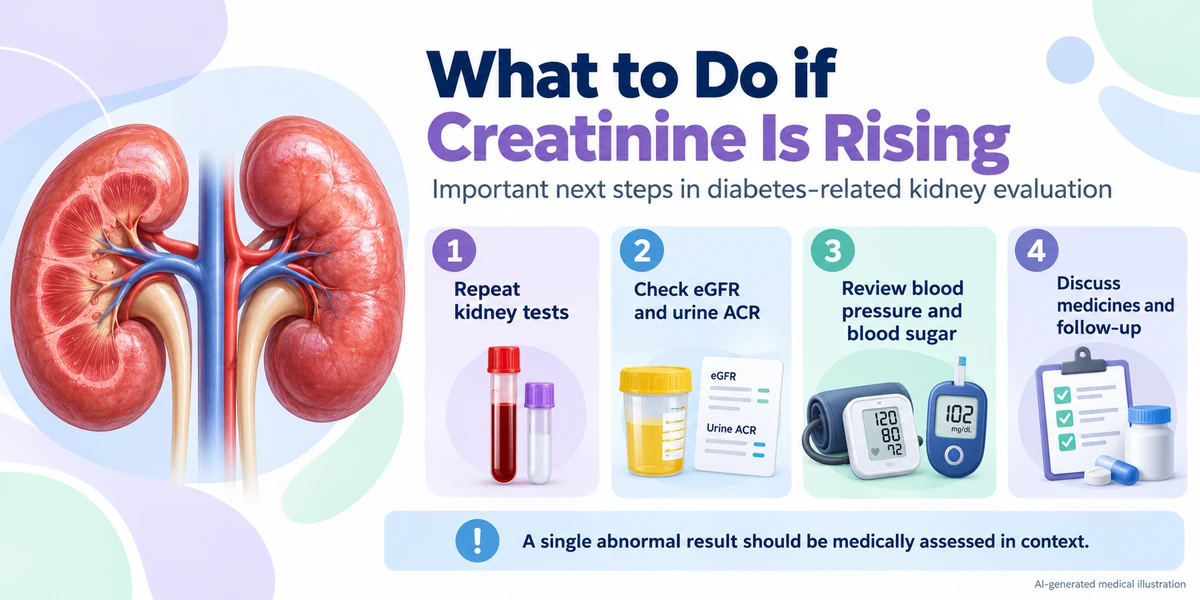
A clinician may follow an individualised evaluation process.
Earlier serum creatinine measurements help identify the size and timing of the increase.
Relevant history may include vomiting, diarrhoea, fever, infection, reduced fluid intake and changes in urine output.
The clinician may review prescription medicines, NSAIDs, supplements and recent treatment changes.
Blood pressure, symptoms of dehydration or fluid overload, and general clinical findings can help identify contributing factors.
Further tests may include potassium, bicarbonate, urinalysis, urine ACR and repeat kidney function measurements.
Kidney ultrasound or additional tests may be appropriate when obstruction or another kidney condition is suspected.
Rapid or severe changes may require urgent evaluation.
More stable abnormalities may be monitored according to their significance and underlying cause.
There is no universal repeat-testing interval appropriate for every person.
Yes.
ACE inhibitors and ARBs can cause an initial reduction in pressure inside the kidneys’ filtering units, which may result in a modest rise in serum creatinine.
In appropriate patients, these medicines can reduce albuminuria and provide long-term kidney benefits.
The ADA Standards of Care in Diabetes—2026 advises against automatically discontinuing renin–angiotensin system blockade for a mild-to-moderate creatinine increase of up to 30% when there is no evidence of extracellular fluid volume depletion.
However, such changes require clinical interpretation, and potassium or kidney function monitoring may be appropriate.
Larger changes, concerning symptoms or other abnormalities may require investigation and treatment adjustment.
This information is not an instruction to continue or stop a particular medicine without medical review.
Sometimes.
Creatinine may decrease when reversible factors are identified and appropriately treated.
For example, kidney function may improve after recovery from dehydration, resolution of an acute illness or treatment of urinary obstruction.
However, improvement is not guaranteed.
Established chronic kidney scarring may not be fully reversible.
A lower creatinine measurement does not necessarily prove that the underlying kidney condition has been cured.
The appropriate aim is to identify the cause, manage associated risks and preserve kidney function where possible.
Management depends on the clinical diagnosis and associated conditions.
Appropriate glucose management may help reduce diabetes-related complications.
HbA1c targets depend on factors such as age, hypoglycaemia risk, other conditions and treatment.
A single target is not suitable for everyone.
High blood pressure is an important contributor to kidney and cardiovascular risk.
Treatment goals should be individualised according to the clinical condition and treatment tolerance.
ACE inhibitors, ARBs, SGLT2 inhibitors and other medicines may be helpful in eligible patients.
Each has specific indications, contraindications, adverse effects and monitoring requirements.
SGLT2 inhibitors, for example, can cause a small initial eGFR change that requires interpretation in clinical context.
Adequate fluid intake is important, but excessive water intake does not reverse chronic kidney disease.
People with fluid overload, heart failure or advanced CKD may require different recommendations.
Depending on individual circumstances, recommendations may include:
– Reducing excessive dietary sodium.
– Avoiding tobacco.
– Appropriate physical activity.
– Maintaining adequate nutrition.
– Reviewing supplements and non-prescription medicines.
– Avoiding unnecessary exposure to potentially kidney-harming medicines.
There is no diet, supplement or lifestyle measure that guarantees normal creatinine or reversal of kidney damage.
The ADA Standards of Care in Diabetes—2026 recommends urine ACR and eGFR assessment at least annually in:
– Adults with type 2 diabetes, beginning at diagnosis.
– People with type 1 diabetes of at least five years’ duration.
For established CKD, monitoring may be performed approximately one to four times annually, or more frequently according to clinical circumstances.
An unexpected creatinine increase may require substantially earlier reassessment.
Children and adolescents have age-specific recommendations.
Nephrology assessment may be appropriate when:
– eGFR declines progressively.
– Creatinine rises unexpectedly or the cause remains uncertain.
– Albuminuria is severely increased or rises rapidly.
– Blood and protein are found together in urine.
– Blood pressure remains difficult to control with kidney abnormalities.
– Significant electrolyte disturbances are present.
– Advanced CKD is identified.
– Another kidney disease is suspected.
An eGFR below 30 mL/min/1.73 m² is a commonly recognised reason to consider specialist referral, although assessment may be appropriate at higher values depending on the clinical findings.
Not every isolated abnormal creatinine measurement requires nephrology referral.
Seek immediate emergency assessment for:
– Severe breathlessness.
– Chest pain.
– Confusion or loss of consciousness.
– Seizures.
– Very little or no urine output with significant illness.
– Rapidly worsening swelling with breathing difficulty.
Sudden major changes in kidney test results, severe dehydration, persistent vomiting or severe illness may also require urgent medical assessment.
A specific creatinine number should not be used as the only criterion for seeking urgent care.
The following information may help during clinical assessment.
| Report or Information | Why It May Be Useful |
|---|---|
| Current Serum Creatinine | Shows the latest measurement. |
| Previous Creatinine Reports | Helps identify the rate of change. |
| eGFR Results | Supports kidney filtration assessment. |
| Urine ACR | Helps assess albumin leakage. |
| Urinalysis | May identify blood or other abnormalities. |
| Potassium and Electrolytes | Helps assess complications. |
| HbA1c or Glucose Results | Supports diabetes assessment. |
| Blood Pressure Records | Helps evaluate hypertension. |
| Current Medication List | Supports medicine safety review. |
| Recent Illness History | May identify acute contributing factors. |
| Urine Output Changes | May indicate an acute problem. |
Important: Not every person requires all these investigations. Test selection and urgency should be based on clinical findings.
Possible causes include diabetic kidney disease, acute kidney injury, dehydration, high blood pressure, urinary obstruction and certain medication effects. The cause cannot be determined from creatinine alone.
No. Creatinine may rise temporarily or because of acute or chronic conditions. Kidney failure assessment depends on kidney function, symptoms and other findings.
There is no universal dangerous creatinine value. The size and speed of the change, previous measurements and associated clinical findings are important.
Yes. Reduced kidney filtration may occur without increased urinary albumin. Urine ACR and eGFR assess different aspects of kidney health.
Yes. A modest initial rise may occur. These medicines can still provide kidney benefits in eligible patients. Changes should be assessed and monitored clinically.
Yes. Significant dehydration can reduce kidney blood flow and contribute to acute kidney injury. However, not every elevated creatinine result is caused by dehydration
It may improve when a reversible cause is treated, but complete recovery cannot be guaranteed. Established chronic kidney damage may not be reversible.
Dialysis may be considered when severe kidney dysfunction leads to symptoms or complications that cannot be adequately managed otherwise. It is not determined by one creatinine value or eGFR result alone.
Rising creatinine in diabetes is an important finding that requires interpretation in the context of previous results and the patient’s medical condition.
It may reflect an acute reversible problem, chronic kidney disease, medication-related changes or another underlying cause.
Serum creatinine, eGFR and urine ACR provide complementary information, while blood pressure, electrolyte results, symptoms and medical history help guide further assessment.
An unexpected or rapidly increasing creatinine level should not be ignored, but it does not automatically mean permanent kidney damage or dialysis is necessary.
Individualised medical assessment is essential for determining the cause and appropriate management.
Medical Information: Dr. Jyoti Bansode | MBBS, MD Medicine, DM Nephrology | Medical Registration No.: 2011/06/1863 | Maharashtra Medical Council (MMC).
Medical Review Status: Pending review and approval by Dr. Jyoti Bansode.
Medical Disclaimer: Website content and visuals are for general informational, educational and representational purposes only, may not reflect individual patient conditions or outcomes, and do not replace personalised medical advice, diagnosis or clinical assessment.
Plot no 70, Moreshwar Heritage, Sector 5, Ulwe, Navi Mumbai, Maharashtra 410206
For Booking: +91 8591009591
Chat With Us
Mini Sea Shore Road, Juhu Nagar, Sector 10A, Vashi, Navi Mumbai, Maharashtra 400703
Chat With Us