
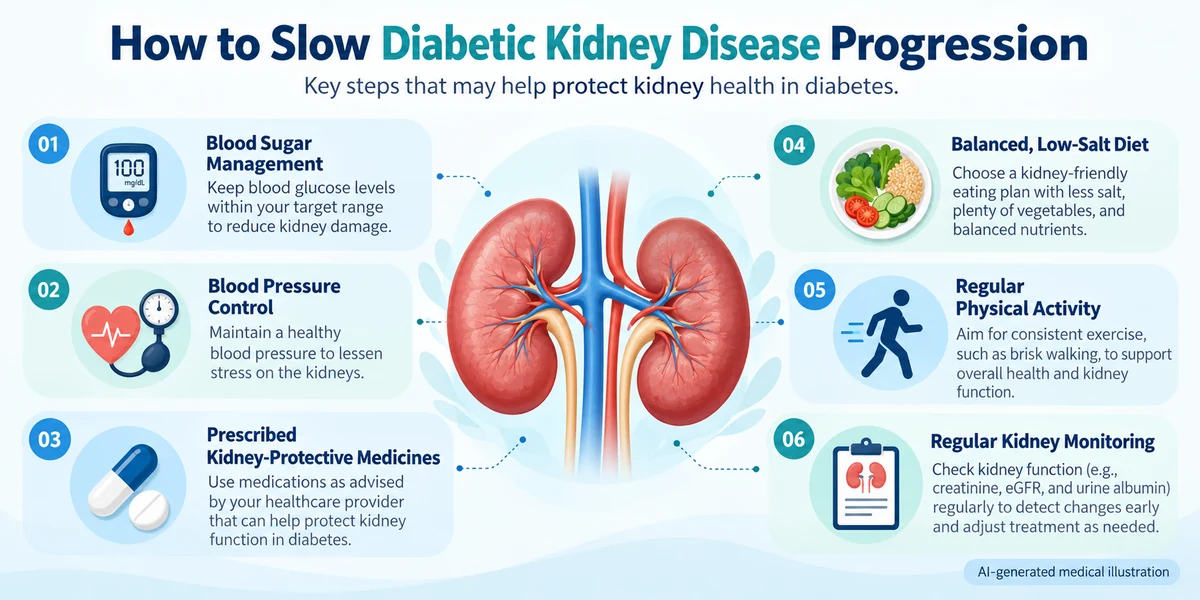
Diabetic kidney disease progression can often be slowed through appropriate blood glucose management, blood pressure control, kidney-protective medicines, dietary measures, physical activity and regular kidney monitoring. However, treatment outcomes vary, and no approach guarantees that kidney damage will stop or reverse completely.
Diabetic kidney disease (DKD) can develop gradually, sometimes without noticeable symptoms. Early abnormalities may appear as increased albumin in urine, reduced estimated glomerular filtration rate (eGFR), or both.
Monitoring urine albumin-to-creatinine ratio (uACR) and eGFR helps identify kidney abnormalities and track changes over time.
This article explains ten evidence-based approaches to managing diabetic kidney disease, including treatment considerations, diet, kidney testing and warning signs.
Diabetic kidney disease refers to kidney damage associated with diabetes.
The kidneys contain microscopic filtering structures called glomeruli. These structures help remove waste products and excess fluid from the bloodstream while retaining most essential proteins.
Long-term elevated blood glucose can affect the kidneys’ blood vessels and filtering structures.
Possible changes include:
Increased albumin leakage into urine.
Injury to the glomerular filtration barrier.
Gradual reduction in kidney filtration.
Changes in fluid and electrolyte balance as dysfunction advances.
Increased risk of cardiovascular complications.
High blood pressure may contribute to further kidney injury.
However, not everyone with diabetes develops kidney disease, and not every abnormal kidney result in someone with diabetes is caused by diabetes.
For related information, read Diabetic Kidney Disease Symptoms.
Yes. Appropriate medical management can reduce the risk of kidney disease progression in eligible patients.
Treatment may help reduce albuminuria, slow the decline in eGFR and lower the risk of certain cardiovascular complications.
However, the response depends on several factors:
Existing kidney function.
Urine albumin levels.
Duration and type of diabetes.
Blood pressure.
Cardiovascular health.
Other kidney disorders.
Current medicines and treatment tolerance.
Some people experience stable kidney function or improved urine albumin measurements. Others may continue to experience declining kidney function despite appropriate treatment.
Slowing progression is not the same as curing established chronic kidney disease.
Several factors may contribute to kidney-related risk.
Long-term hyperglycaemia may contribute to blood vessel injury and changes in kidney filtration.
Hypertension can worsen kidney damage and increase cardiovascular risk.
Persistent albuminuria is associated with kidney damage and may indicate an increased risk of progression.
A sustained decline in eGFR may suggest worsening kidney filtration.
Heart and blood vessel conditions frequently coexist with chronic kidney disease.
Smoking increases vascular and cardiovascular risks.
Other medical conditions, certain medicines, acute kidney injury and urinary obstruction may also affect kidney function.
The overall risk should be assessed using clinical findings and changes in laboratory results over time.
Appropriate blood glucose management is important for reducing diabetes-related complications.
HbA1c reflects average blood glucose over approximately the previous two to three months.
A target near 7% may be suitable for many non-pregnant adults with diabetes, but it is not appropriate for everyone.
Individual HbA1c targets depend on:
Age and general health.
Risk of hypoglycaemia.
Kidney function.
Diabetes duration.
Cardiovascular disease.
Other medical conditions.
Current treatment.
In people with advanced kidney disease, HbA1c interpretation may sometimes be affected by anaemia and changes in red blood cell turnover.
Home glucose monitoring or continuous glucose monitoring may provide additional information when appropriate.
Patients should not adjust prescribed diabetes medicines independently to reach a particular HbA1c target.
High blood pressure is an important contributor to kidney and cardiovascular complications.
Blood pressure management may help reduce the risk of diabetic kidney disease progression.
For many adults with diabetes, a blood pressure target below 130/80 mmHg may be considered when safely achievable. However, targets should be individualised according to clinical circumstances and treatment tolerance.
Excessively aggressive treatment can cause problems such as dizziness, low blood pressure or reduced circulation in susceptible individuals.
Management may include:
Appropriate prescribed medicines.
Reducing excessive dietary sodium.
Physical activity.
Weight management when indicated.
Home blood pressure monitoring where appropriate.
Not everyone needs the same monitoring frequency or medicine combination.
Certain medicines have demonstrated kidney or cardiovascular benefits in eligible patients.
Their suitability depends on diabetes type, eGFR, urine albumin, blood pressure, associated conditions and potential adverse effects.
Angiotensin-converting enzyme inhibitors (ACE inhibitors) and angiotensin receptor blockers (ARBs) may reduce albuminuria and kidney-related risk in selected people, particularly when hypertension and albuminuria are present.
They can affect serum creatinine, potassium and blood pressure.
Monitoring may be needed after starting treatment or adjusting the dose.
ACE inhibitors and ARBs should not routinely be combined.
Certain sodium-glucose cotransporter-2 (SGLT2) inhibitors have demonstrated benefits in reducing kidney disease progression and cardiovascular events.
They are recommended for many eligible people with type 2 diabetes and CKD.
Potential adverse effects include genital infections, volume depletion and, rarely, ketoacidosis.
Medication management during acute illness or around certain procedures may require specific medical guidance.
Selected glucagon-like peptide-1 receptor agonists may offer kidney and cardiovascular benefits in people with type 2 diabetes and CKD.
Potential adverse effects and contraindications must be considered.
Finerenone may benefit selected people with type 2 diabetes, CKD and persistent albuminuria.
It can increase potassium and requires appropriate clinical and laboratory monitoring.
Important: Not everyone requires every kidney-protective medicine. Prescribing decisions should be made by a qualified healthcare professional.
Excess dietary sodium can contribute to high blood pressure and fluid retention.
Reducing excessive salt intake may support blood pressure and kidney management.
KDIGO guidance suggests sodium intake below approximately 2 grams per day, equivalent to about 5 grams of salt, for many adults with CKD.
However, dietary advice should be individualised. Certain medical conditions may require a different approach.
Practical measures include:
Reducing added salt during cooking.
Checking sodium content on food labels.
Limiting frequently consumed salty snacks.
Moderating pickles, papad and highly processed foods.
Using herbs and spices for flavour.
The goal is to reduce excessive sodium consumption without compromising overall nutrition.
Dietary requirements vary according to kidney function, nutritional status, blood glucose and associated medical conditions.
A suitable eating pattern may include appropriate portions of:
Non-starchy vegetables.
Whole grains or other carbohydrate sources.
Legumes and suitable protein sources.
Healthy unsaturated fats.
Other foods selected according to individual nutritional needs.
People with advanced CKD may require additional adjustments to potassium, phosphorus or protein intake.
These restrictions are not automatically necessary for everyone with diabetes.
For many adults with CKD stages G3–G5 who are not receiving dialysis, a protein intake around 0.8 g/kg body weight per day may be considered.
However, this is not a universal prescription.
Protein requirements can differ in people with malnutrition, frailty, acute illness or those receiving dialysis.
A renal dietitian may help determine an appropriate eating plan when needed.
Extreme protein restriction should not be started without medical and nutritional assessment.
Appropriate physical activity may support blood glucose management, cardiovascular health and blood pressure control.
For many adults, approximately 150 minutes of moderate-intensity aerobic activity weekly may be appropriate.
Possible activities include:
Walking.
Cycling.
Swimming.
Other suitable aerobic exercise.
Resistance exercises may also be considered.
Exercise recommendations should reflect fitness, mobility, cardiovascular conditions and kidney function.
People with significant medical limitations may need an individualised plan.
Tobacco use is associated with vascular injury and increased cardiovascular risk.
Avoiding smoking and other tobacco products is an important part of overall diabetes and kidney care.
Stopping tobacco use may improve health-related risks, but it does not guarantee reversal of established kidney damage.
Some medicines can affect kidney function.
Nonsteroidal anti-inflammatory drugs (NSAIDs), such as ibuprofen and naproxen, may contribute to kidney injury in susceptible individuals, particularly during dehydration or acute illness.
Other medicines may need dose adjustments when eGFR changes.
Unverified herbal supplements and products marketed as kidney cleansers may also carry risks.
A medication review may consider:
Prescribed medicines.
Over-the-counter pain medicines.
Herbal preparations.
Nutritional supplements.
Recent changes in treatment.
Do not stop prescribed medicines independently because of an abnormal creatinine result.
Adequate hydration is important for normal body function.
However, drinking large amounts of water does not reverse chronic kidney damage.
Fluid requirements depend on kidney function, heart function, fluid losses and other medical conditions.
Some people with advanced CKD or heart failure may require fluid restrictions.
Vomiting, diarrhoea, infection and other acute illnesses can cause temporary or serious changes in kidney function.
Significant illness may require timely clinical evaluation and review of fluid management and medicines.
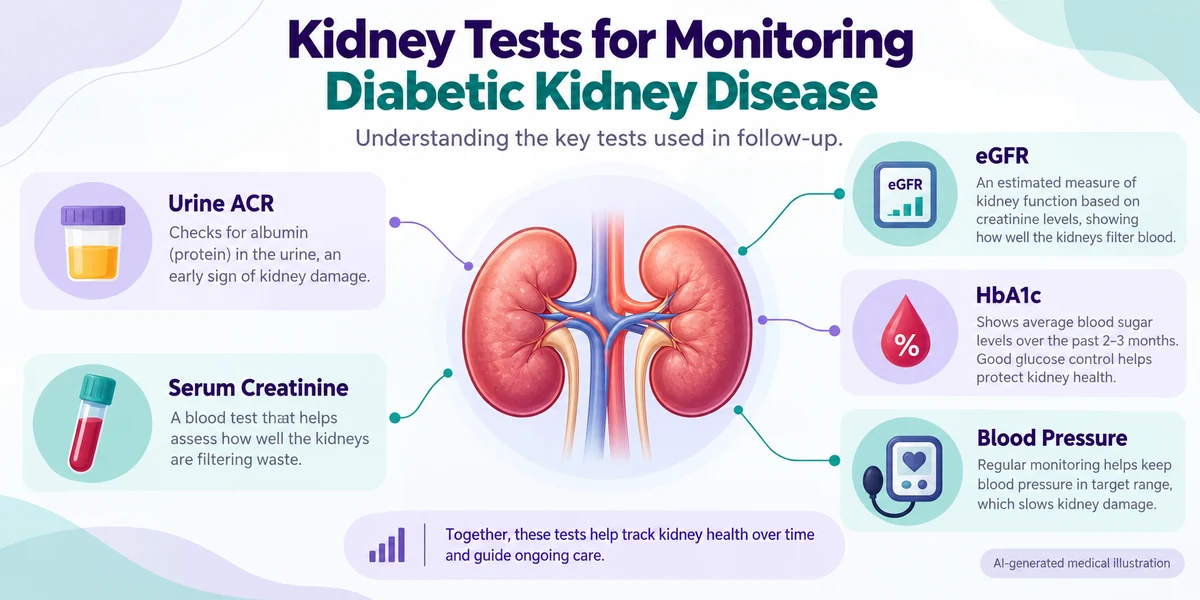
Regular blood and urine testing helps identify changes that may not produce noticeable symptoms.
Two particularly important tests are:
Urine ACR: Measures albumin relative to creatinine in urine.
eGFR: Estimates kidney filtration.
These tests provide complementary information.
Additional monitoring may include serum creatinine, potassium, bicarbonate, HbA1c and blood pressure.
The appropriate testing frequency depends on the stage of kidney disease and individual clinical circumstances.
Read more about Kidney Tests Explained.
| Test | What It Evaluates | Why It Matters |
|---|---|---|
| Urine ACR | Albumin leakage in urine | Helps assess kidney damage and progression risk |
| Serum Creatinine | Creatinine concentration in blood | Supports assessment of kidney filtration |
| eGFR | Estimated kidney filtering function | Helps monitor filtration over time |
| Urinalysis | Blood, protein and other urine findings | May identify additional abnormalities |
| HbA1c | Average blood glucose over approximately 2–3 months | Supports diabetes management |
| Blood Pressure | Arterial blood pressure | Helps assess hypertension |
| Potassium | Blood potassium concentration | Supports electrolyte and medication safety assessment |
| Bicarbonate | Blood bicarbonate concentration | May help assess acid–base abnormalities |
Not every person requires all these tests at every follow-up.
Urine ACR is commonly reported in milligrams of albumin per gram of creatinine (mg/g).
| Urine ACR | Category | General Interpretation |
|---|---|---|
| Below 30 mg/g | A1 | Normal to mildly increased |
| 30–299 mg/g | A2 | Moderately increased albuminuria |
| 300 mg/g or above | A3 | Severely increased albuminuria |
Important: Persistent albuminuria may indicate kidney damage, but a single abnormal urine ACR does not automatically confirm chronic kidney disease (CKD).
Fever, urinary infection, strenuous exercise, markedly elevated blood glucose and other factors may temporarily increase urine albumin. Repeat testing may be required.
Learn more about Urine ACR Test Explained .
| eGFR (mL/min/1.73 m²) | Category | General Interpretation |
|---|---|---|
| 90 or above | G1 | Normal or high |
| 60–89 | G2 | Mildly decreased |
| 45–59 | G3a | Mildly to moderately decreased |
| 30–44 | G3b | Moderately to severely decreased |
| 15–29 | G4 | Severely decreased |
| Below 15 | G5 | Kidney failure range |
Important: G1 and G2 do not independently establish CKD without another persistent marker of kidney damage.
Chronic kidney disease generally requires kidney abnormalities lasting at least three months.
eGFR and urine ACR should be interpreted together, along with the underlying diagnosis.
Yes.
Some people with diabetes develop reduced kidney filtration without significantly increased albuminuria.
This is sometimes described as non-albuminuric diabetic kidney disease.
However, reduced eGFR may also be caused by other kidney disorders.
A normal urine ACR does not exclude every type of kidney disease.
Similarly, increased urine albumin does not automatically prove that diabetes is responsible.
Yes.
Some people have increased urine albumin while serum creatinine remains within the laboratory reference range.
Serum creatinine helps estimate kidney filtration but does not directly measure albumin leakage.
Therefore, urine ACR and eGFR are useful complementary investigations.
For additional information, read Diabetic Kidney Disease With Normal Creatinine.
The American Diabetes Association Standards of Care in Diabetes—2026 recommends:
For adults with type 1 diabetes, urine ACR and eGFR testing is generally recommended at least annually after five years of diabetes duration.
For adults with type 2 diabetes, urine ACR and eGFR testing is generally recommended at least annually from diagnosis, regardless of treatment.
People with CKD may require monitoring approximately one to four times annually, or more often when clinically indicated.
The frequency depends on eGFR, urine ACR, kidney disease progression, current medicines and associated complications.
Children and adolescents require age-specific screening recommendations.
Quarterly kidney testing is not universally necessary for everyone with diabetes.
Progression is generally assessed by reviewing changes over time rather than relying on one laboratory measurement.
A sustained decrease in eGFR may suggest worsening filtration.
However, temporary changes may occur during acute illness or after certain treatment adjustments.
Increasing albuminuria may indicate greater kidney-related risk.
However, urine albumin can vary between samples, so repeat testing and clinical interpretation may be needed.
Blood pressure, blood glucose and HbA1c measurements help identify associated risk factors.
Advanced kidney dysfunction may be associated with anaemia, electrolyte abnormalities, acidosis or fluid retention.
These findings require assessment according to the underlying condition.
Yes.
Some people experience reduced urine albumin after appropriate treatment.
Improvement may follow better blood pressure management, diabetes care or selected kidney-protective medicines.
However, an improved urine ACR does not necessarily prove that chronic kidney damage has fully reversed.
Follow-up testing may help determine whether improvement is sustained.
Some early kidney abnormalities may improve with treatment.
However, established chronic kidney scarring is often not fully reversible.
The outcome depends on:
The underlying cause and severity.
Kidney function at diagnosis.
Urine albumin levels.
Blood pressure.
Diabetes duration and management.
Other medical conditions.
Treatment response.
No treatment guarantees complete recovery or prevention of dialysis.
The goal of management is to reduce avoidable risks, preserve kidney function when possible and prevent or manage complications.
Early diabetic kidney disease often causes no noticeable symptoms.
As kidney dysfunction progresses, possible findings may include:
Swelling in the feet or ankles.
Puffiness around the eyes.
Persistent foamy urine.
Fatigue.
Changes in urination.
Difficult-to-control blood pressure.
Reduced appetite or nausea.
These symptoms can also occur in conditions unrelated to kidney disease.
Laboratory investigations are necessary for appropriate evaluation.
Specialist kidney assessment may be appropriate when:
Urine ACR is severely increased or rises rapidly.
eGFR declines progressively.
Serum creatinine changes unexpectedly.
Blood and protein are detected together in urine.
Blood pressure remains difficult to control with kidney abnormalities.
Significant electrolyte disturbances occur.
Advanced CKD is suspected.
The cause of kidney abnormalities remains uncertain.
An eGFR below 30 mL/min/1.73 m² is a commonly recognised reason for specialist referral, although earlier assessment may be appropriate when other concerning findings are present.
Not everyone with mildly increased urine albumin requires immediate nephrology referral.
Seek immediate emergency medical care for:
Severe breathlessness.
Chest pain.
Confusion or loss of consciousness.
Seizures.
Very little or no urine output accompanied by significant illness.
Rapidly worsening swelling with difficulty breathing.
Visible blood in urine, persistent vomiting, severe flank pain with fever or unexpectedly rapid deterioration in kidney function may also require timely assessment.
These symptoms may have causes unrelated to diabetic kidney disease.
The following records may help during clinical assessment.
| Report or Information | Why It May Be Useful |
|---|---|
| Previous Serum Creatinine | Helps identify changes in kidney function |
| eGFR Reports | Helps assess filtration trends |
| Urine ACR Results | Helps monitor albuminuria |
| HbA1c and Glucose Records | Supports diabetes management assessment |
| Blood Pressure Readings | Helps evaluate hypertension |
| Potassium and Other Electrolytes | May identify complications or treatment-related changes |
| Current Medicines | Supports medication safety review |
| Dietary History | Helps assess nutritional needs |
| Recent Illness History | May identify temporary influences |
| Previous Kidney Investigations | Provides additional diagnostic context |
Important: Not every patient requires every investigation. Testing and follow-up frequency should be based on clinical findings.
Yes. Appropriate blood glucose management, blood pressure control, selected medicines and regular kidney monitoring may reduce progression risk in eligible patients.
Some early abnormalities may improve, but established chronic kidney damage may not be fully reversible.
ACE inhibitors, ARBs, SGLT2 inhibitors, GLP-1 receptor agonists and certain other medicines may benefit selected patients. Treatment depends on individual clinical indications.
Annual screening is generally recommended for adults with type 2 diabetes and people with type 1 diabetes of at least five years’ duration. Established CKD may require more frequent monitoring.
No. Proteinuria may result from diabetes, hypertension, other kidney diseases or temporary medical conditions.
No. Protein requirements depend on kidney function, nutritional status, whether dialysis is being received and other medical factors.
Yes. Existing kidney damage, hypertension, cardiovascular conditions and other factors may contribute to progression despite appropriate glucose management.
No. Many people with diabetic kidney disease do not require dialysis. The need depends on kidney function, symptoms, complications and clinical assessment.
Slowing diabetic kidney disease progression requires an individualised approach involving blood glucose management, blood pressure control, appropriate medicines, balanced nutrition and regular kidney monitoring.
Urine ACR and eGFR are important complementary tests because kidney abnormalities may occur before noticeable symptoms develop.
Evidence-based treatments may reduce progression and cardiovascular risks in eligible patients.
However, treatment response varies, and no medicine, diet or lifestyle strategy guarantees complete reversal of established kidney damage.
Ongoing medical evaluation helps determine appropriate management and monitoring.
Medical Information: Dr. Jyoti Bansode | MBBS, MD Medicine, DM Nephrology | Medical Registration No.: 2011/06/1863 | Maharashtra Medical Council (MMC).
Medical Disclaimer: Website content and visuals are for general informational, educational and representational purposes only, may not reflect individual patient conditions or outcomes, and do not replace personalised medical advice, diagnosis or clinical assessment.
Plot no 70, Moreshwar Heritage, Sector 5, Ulwe, Navi Mumbai, Maharashtra 410206
For Booking: +91 8591009591
Chat With Us
Mini Sea Shore Road, Juhu Nagar, Sector 10A, Vashi, Navi Mumbai, Maharashtra 400703
Chat With Us