
Persistent proteinuria means that increased amounts of protein continue to be detected in urine on repeated testing. It may indicate an underlying kidney disorder, but it does not automatically mean that the kidneys have failed.
Protein may appear temporarily in urine during fever, acute illness, strenuous exercise or other physiological changes. When proteinuria remains present, further evaluation helps determine the amount of protein, its possible cause and whether kidney function is affected.
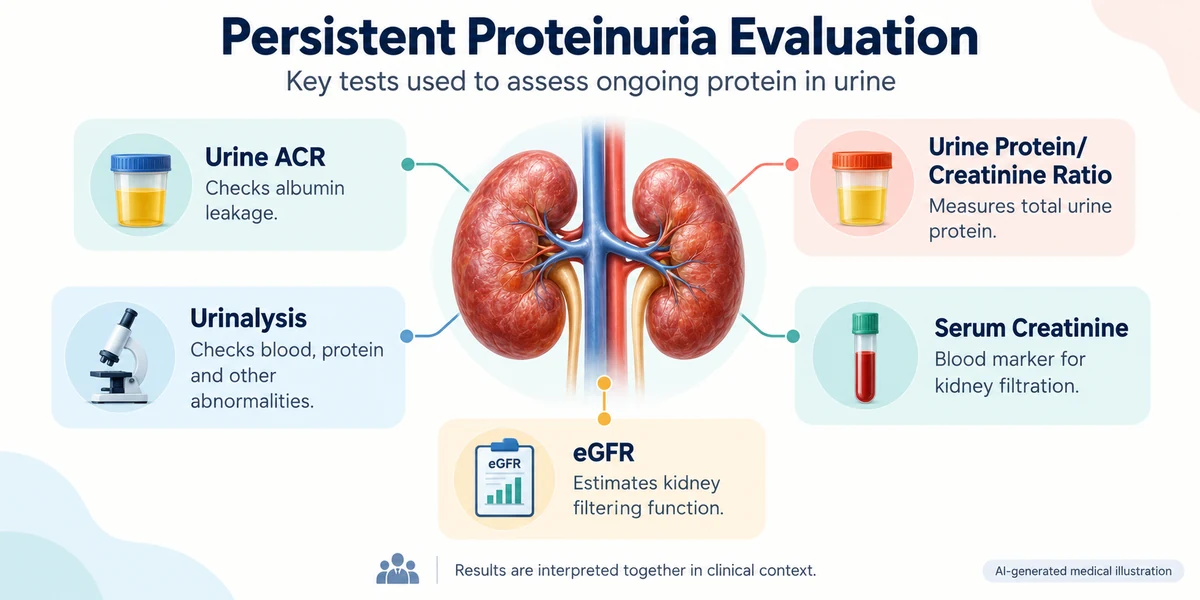
Common investigations include urine albumin-to-creatinine ratio (uACR), urine protein-to-creatinine ratio (UPCR), urinalysis, serum creatinine and estimated glomerular filtration rate (eGFR).
Depending on clinical findings, additional tests such as kidney ultrasound, immune-related blood investigations or kidney biopsy may be considered.
A single abnormal urine test does not establish chronic kidney disease. Repeat results, the duration of abnormalities and the patient’s medical history are important for interpretation.
Proteinuria refers to the presence of more protein in urine than normally expected.
Healthy kidneys contain microscopic filtering structures called glomeruli. These structures help filter waste products and excess fluid from the blood while retaining most essential proteins.
The kidney tubules also help reabsorb certain filtered proteins.
Proteinuria may develop when:
– The glomerular filtration barrier is affected.
– Kidney tubules cannot adequately reabsorb filtered proteins.
– The body produces increased amounts of certain proteins.
– Temporary physiological or medical factors influence urine protein excretion.
Persistent proteinuria is identified when abnormal urinary protein excretion remains present on repeat assessment.
The clinical significance depends on the amount and type of protein, accompanying findings and underlying medical condition.
Proteinuria may be temporary or ongoing.
| Feature | Temporary proteinuria | Persistent proteinuria |
|---|---|---|
| Duration | Resolves after the contributing factor improves | Remains present on repeated testing |
| Possible causes | Fever, exercise, acute illness or dehydration-related influences | Diabetes, hypertension, glomerular disease or other disorders |
| Symptoms | Often absent | May be absent or accompanied by other findings |
| Testing | Repeat urine examination may confirm resolution | Quantitative urine tests and further evaluation may be appropriate |
| Management | Depends on the temporary cause | Depends on the underlying condition and kidney findings |
An isolated abnormal dipstick is not sufficient to determine which category applies.
No.
Persistent proteinuria may be a marker of kidney damage, but chronic kidney disease (CKD) generally requires an abnormality of kidney structure or function lasting at least three months and having implications for health.
The duration of abnormal findings may be established through previous test reports, medical history, repeat investigations or other evidence.
A newly detected abnormal result may also represent an acute kidney condition that requires earlier assessment.
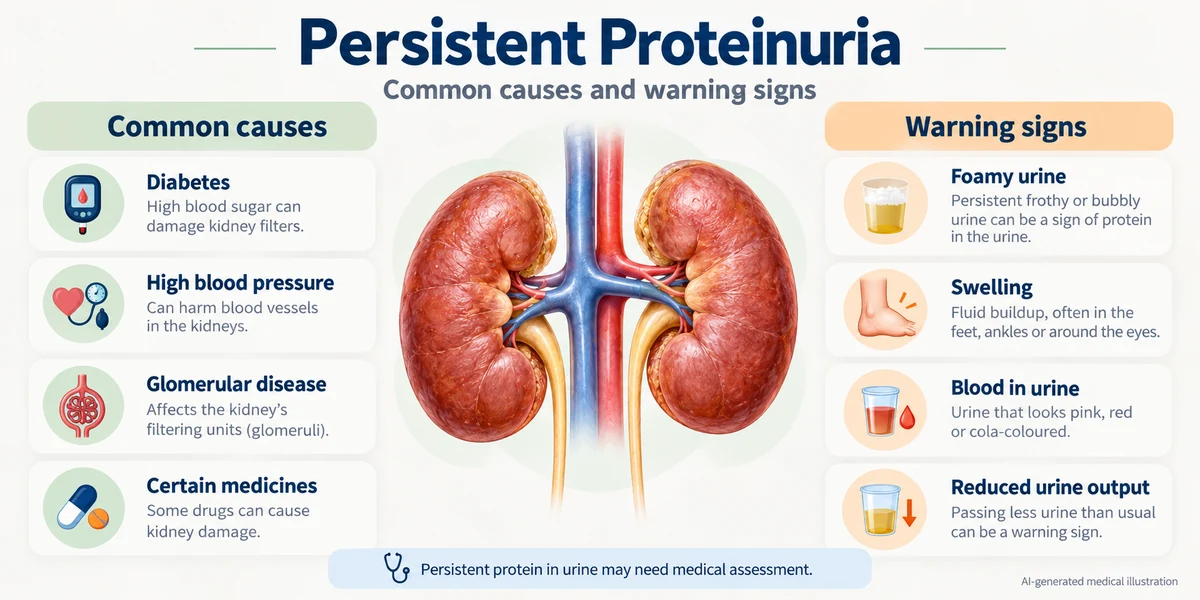
Long-term elevated blood glucose can affect the kidneys’ small blood vessels and filtering structures.
This may lead to increased urinary albumin excretion, sometimes before eGFR declines substantially.
However, not everyone with diabetes develops albuminuria, and an abnormal urine protein result does not automatically mean diabetes is the underlying cause.
Read more about Diabetic Kidney Disease Symptoms.
Persistently elevated blood pressure can damage small blood vessels in the kidneys.
Hypertension may contribute to albuminuria and declining kidney function.
Kidney disease can also make blood pressure more difficult to manage.
Glomerular disorders affect the kidneys’ filtering structures.
Examples include:
IgA nephropathy.
Membranous nephropathy.
Focal segmental glomerulosclerosis (FSGS).
Minimal change disease.
Lupus nephritis.
These conditions may cause proteinuria, blood in urine, swelling or reduced kidney filtration.
Their diagnosis and treatment depend on the particular disorder.
Persistent proteinuria can occur in several forms of chronic kidney disease.
However, CKD may also develop without increased urinary albumin.
eGFR, urine findings and the underlying cause should be evaluated together.
Some inherited conditions can cause persistent proteinuria.
A relevant family history, hearing abnormalities, kidney structural findings or other clinical features may prompt additional investigation.
Genetic testing is considered only in appropriate circumstances.
Some diseases affect the kidney tubules rather than primarily damaging the glomeruli.
These conditions can produce increased urinary excretion of proteins that are not adequately detected by an albumin-specific test alone.
Some medicines, including certain non-steroidal anti-inflammatory drugs (NSAIDs), may contribute to kidney injury.
Other inflammatory, infectious or systemic conditions may also be associated with proteinuria.
Medication history is therefore an important part of evaluation.
Do not stop prescribed medicines independently because proteinuria is detected. A healthcare professional should assess the possible contribution of treatment.
Yes.
Temporary proteinuria may occur during:
– Fever.
– Acute infections or other illnesses.
– Strenuous physical exercise.
– Significant physiological stress.
– Dehydration or concentrated urine.
In some younger individuals, orthostatic proteinuria may occur, meaning urinary protein increases during upright activity but is absent or within the expected range after lying down overnight.
A first-morning urine sample may help identify this pattern.
When an abnormal result is detected, a clinician may recommend repeating the test after relevant temporary factors have resolved.
Mild proteinuria frequently causes no noticeable symptoms.
Some people with significant protein loss or underlying kidney disease may experience:
Persistent foam may sometimes be associated with increased urinary protein.
However, rapid urine flow and other non-disease factors can also cause foam.
A urine test is required to confirm proteinuria.
Substantial protein loss may be associated with low blood albumin and fluid accumulation.
This can contribute to puffiness around the eyes.
Fluid retention can occur with certain kidney conditions.
However, swelling also has possible cardiac, liver-related, medication-related and other causes.
Fatigue may occur in people with associated kidney dysfunction or other underlying conditions.
It is not specific to proteinuria.
Proteinuria may occur together with hematuria, meaning blood in urine.
This combination may require evaluation for a glomerular disorder or another urinary condition.
Hypertension may coexist with proteinuria and increase kidney-related risk.
Important: The presence or absence of symptoms cannot reliably determine the amount of urinary protein or identify the underlying cause.
A systematic evaluation begins with confirming and quantifying the urine abnormality and assessing kidney filtration.
A urine dipstick is a commonly used screening investigation.
It can detect protein, particularly albumin, but does not accurately measure the full amount of urinary protein.
Results may be influenced by urine concentration and other factors.
A positive dipstick result may require confirmation with a quantitative urine test.
Urine ACR measures albumin relative to creatinine in a urine sample.
It helps account for differences in urine concentration and is important when evaluating diabetes-related kidney abnormalities and chronic kidney disease.
A spot urine specimen is commonly used.
| Urine ACR (mg/g) | Category | General interpretation |
|---|---|---|
| Below 30 | A1 | Normal to mildly increased |
| 30–299 | A2 | Moderately increased albuminuria |
| 300 or above | A3 | Severely increased albuminuria |
A urine ACR of 30 mg/g or above falls into an increased albuminuria category.
However, a single abnormal result does not automatically establish CKD.
Learn more about the Urine ACR Test.
Urine PCR measures total urinary protein relative to creatinine.
Unlike urine ACR, which measures albumin specifically, UPCR includes albumin and other proteins.
It may be useful when:
– Significant proteinuria is suspected.
A broader measurement of urinary protein is needed.
– Certain glomerular or tubular conditions are being investigated.
– Monitoring of total protein excretion is clinically indicated.
Urine ACR and UPCR are not interchangeable measurements.
Their values and reference ranges must be interpreted according to the units and clinical situation.
Urinalysis may help identify:
– Protein.
– Blood.
– White blood cells.
– Findings suggesting urinary infection.
– Other urine abnormalities.
Microscopic examination may identify red blood cell casts or other findings that help assess the possible source of kidney injury.
Urine findings must be interpreted together with symptoms and laboratory results.
Serum creatinine is a blood marker used to estimate kidney filtration.
An elevated creatinine level may indicate reduced kidney function.
However, creatinine is influenced by muscle mass, medicines and other factors.
A normal creatinine result does not necessarily exclude significant proteinuria.
eGFR estimates how effectively the kidneys filter blood.
It provides important information about kidney function but does not directly measure urinary protein leakage.
Proteinuria may occur even when eGFR is relatively preserved.
Serum albumin may be measured when substantial protein loss or nephrotic syndrome is suspected.
Low blood albumin can accompany heavy urinary protein loss, although it can also have other causes.
Potassium, sodium and bicarbonate measurements may be appropriate when kidney function is reduced or other complications are suspected.
Not every patient requires all these investigations.
These investigations provide complementary information.
| Test | What it evaluates | Main role |
|---|---|---|
| Urine ACR | Albumin relative to creatinine in urine | Helps detect albumin leakage |
| Urine UPCR | Total protein relative to creatinine in urine | Helps quantify broader protein loss |
| Serum creatinine | Creatinine concentration in blood | Helps estimate kidney filtration |
| eGFR | Estimated filtering function | Helps assess reduced kidney filtration |
| Urinalysis | Blood, protein and other urine findings | Helps identify additional abnormalities |
A person may have significant proteinuria while eGFR remains relatively preserved.
Another person may have reduced eGFR with minimal albuminuria.
Results should therefore be evaluated together rather than interpreted in isolation.
For a broader explanation, read Kidney Tests Explained.
The approach depends on the initial urine finding.
A healthcare professional may:
Review the original urine report and the units used.
Assess recent fever, infection, exercise or other possible temporary influences.
Request a repeat urine examination.
Quantify the abnormality using urine ACR, UPCR or another appropriate test.
Prefer a first-morning urine sample when clinically appropriate.
Review previous urine and kidney function results.
Assess how long the abnormality has been present.
Investigate the underlying cause when indicated.
KDIGO guidance recommends confirming positive urine protein findings with quantitative laboratory measurements and confirming elevated random urine ACR results using a subsequent first-morning specimen when feasible.
A newly detected severe abnormality may require prompt assessment rather than waiting several months.
A first-morning urine specimen is collected after sleeping, before normal daytime activities.
It can help reduce variation associated with posture, exercise and other factors.
It is particularly helpful for:
– Confirming an abnormal random urine ACR.
– Evaluating possible orthostatic proteinuria.
– Improving consistency between measurements in selected patients.
A random spot urine sample is still acceptable for many initial assessments.
A 24-hour urine collection is not routinely necessary for every person with proteinuria.
A timed urine collection may be considered when a more precise measurement of urinary protein excretion could influence medical decisions.
However, such collections are inconvenient and can be affected by incomplete collection.
Spot urine ACR or UPCR testing is commonly used for initial and ongoing evaluation.
The choice of investigation depends on the medical condition, laboratory findings and need for measurement accuracy.
Further investigations depend on the suspected cause of proteinuria.
These may help assess diabetes and longer-term glucose management.
Selected immune-related tests may be requested when a disease such as lupus nephritis or vasculitis is suspected.
They may include:
– Antinuclear antibodies (ANA).
– Anti-double-stranded DNA antibodies.
– ANCA testing.
– Complement levels such as C3 and C4.
These tests are not routinely necessary for every person with proteinuria.
Testing for certain infections may be appropriate when the medical history or other findings suggest an associated condition.
Further investigations may be recommended when monoclonal proteins, inherited kidney disease or another systemic disorder is suspected.
Unnecessary broad testing should be avoided when there is no relevant clinical indication.
Kidney ultrasound is a non-invasive imaging investigation that may help assess kidney size, structure and certain abnormalities.
It can be considered when:
– A structural kidney condition is suspected.
– Urinary obstruction is possible.
– Kidney function has declined.
– There is a history of certain urinary tract abnormalities.
– Additional anatomical information may help determine the cause.
An ultrasound cannot identify every microscopic kidney disease.
A normal ultrasound does not exclude glomerular or tubular disorders.
Not everyone with mild isolated proteinuria needs an ultrasound.
A kidney biopsy involves obtaining a small tissue sample from the kidney for microscopic examination.
It may help identify the type of kidney injury and guide treatment when the diagnosis remains uncertain.
A biopsy may be considered in selected circumstances such as:
– Suspected glomerular disease.
– Significant proteinuria with an uncertain cause.
– Proteinuria with concerning urine microscopy findings.
– Unexplained deterioration in kidney function.
– Suspected immune-mediated kidney disease.
– Situations in which tissue findings are likely to change treatment decisions.
A biopsy is not automatically required because protein excretion exceeds one specific numerical threshold.
The decision depends on the overall clinical findings, potential benefit and procedural risks.
Possible complications include:
– Pain or discomfort.
– Bleeding.
– Blood in urine after the procedure.
– Rarely, more serious bleeding requiring additional treatment.
The need for biopsy should be discussed through individual medical assessment.
Read more about Kidney Biopsy Preparation and Recovery.
Yes.
Proteinuria can be present even when serum creatinine remains within the laboratory reference range.
Serum creatinine helps estimate overall kidney filtration, while urine ACR and UPCR measure urinary protein leakage.
Some kidney conditions affect the filtration barrier before a substantial decline in eGFR occurs.
Therefore, normal creatinine does not exclude persistent proteinuria or early kidney damage.
Nephrotic-range proteinuria refers to substantial urinary protein loss.
In adults, a commonly used threshold is approximately 3.5 grams of total urinary protein over 24 hours, with corresponding spot urine protein-to-creatinine estimates used in practice.
However, nephrotic-range proteinuria and nephrotic syndrome are not identical.
Nephrotic syndrome generally involves heavy proteinuria, low serum albumin and often swelling, with other possible laboratory abnormalities.
The diagnosis requires evaluation of the full clinical picture.
The presence of heavy proteinuria warrants appropriate medical assessment.
Proteinuria may improve when the underlying condition is appropriately treated or controlled.
The treatment approach depends on the cause and the patient’s clinical condition.
Appropriate blood glucose management may reduce kidney-related complications in people with diabetes.
Individual targets depend on age, diabetes type and other medical factors.
Blood pressure control is important in reducing kidney and cardiovascular risk.
ACE inhibitors and angiotensin receptor blockers (ARBs) may reduce proteinuria in eligible patients.
These medicines have possible adverse effects and may require monitoring of kidney function and potassium.
Certain medicines, including SGLT2 inhibitors, may reduce kidney-related risks in eligible patients with particular forms of chronic kidney disease.
Suitability depends on kidney function, diagnosis, current medicines and associated conditions.
Certain glomerular or immune-related diseases may require specialised treatment.
Therapy varies by diagnosis and may include medicines with important risks and monitoring requirements.
Individualised recommendations may include:
– Reducing excessive sodium intake.
– Avoiding tobacco.
– Maintaining appropriate physical activity.
– Managing body weight when indicated.
– Reviewing medicines and supplements.
– Following nutritional advice appropriate to kidney function.
Patients should not independently adopt extreme protein restrictions or increase fluid intake excessively.
No treatment guarantees complete resolution of proteinuria or prevention of kidney failure.
Sometimes.
Temporary proteinuria may disappear after the triggering condition resolves.
Proteinuria associated with certain medical conditions may also decrease with treatment.
However, persistent kidney disease may require ongoing monitoring or treatment.
An improvement in urine protein levels does not necessarily mean that underlying chronic kidney damage has been completely reversed.
Monitoring frequency depends on:
– Degree of proteinuria or albuminuria.
– eGFR.
– Changes in laboratory results over time.
– Underlying diagnosis.
– Blood pressure and diabetes status.
– Current medicines.
– Other kidney-related complications.
Some people may require relatively infrequent monitoring, while others with significant or rapidly changing findings need more frequent assessment.
A fixed repeat-testing schedule is not appropriate for every patient.
Specialist kidney assessment may be appropriate when:
– Proteinuria is significant or increasing.
– Albuminuria remains severely increased.
– Proteinuria occurs with blood in urine.
– eGFR declines progressively.
– Serum creatinine changes unexpectedly.
– Blood pressure remains difficult to control with kidney abnormalities.
– Nephrotic syndrome is suspected.
– Other findings suggest a glomerular disorder.
– The underlying cause remains uncertain.
Not every person with a mildly increased urine ACR requires immediate specialist referral.
Referral decisions depend on the degree of abnormality, progression risk and clinical findings.
Certain symptoms require prompt or emergency assessment.
Seek emergency medical care immediately for:
– Severe breathlessness.
– Chest pain.
– Confusion or loss of consciousness.
– Seizures.
– Very little or no urine output accompanied by significant illness.
– Rapidly worsening swelling with breathing difficulty.
Visible blood in urine, significant new swelling, severe flank pain with fever or rapidly deteriorating kidney function also warrants timely medical evaluation.
These symptoms may have causes unrelated to proteinuria.
The following records may be useful during medical assessment.
| Report or Information | Why It May Help |
|---|---|
| Previous Urine Dipstick Tests | Helps establish whether protein was detected previously. |
| Urine ACR | Measures albumin relative to creatinine. |
| Urine UPCR | Measures total protein relative to creatinine. |
| Serum Creatinine | Supports assessment of kidney filtration. |
| eGFR | Estimates kidney filtering function. |
| Blood Pressure Records | Helps assess hypertension. |
| Diabetes-Related Results | May help identify associated metabolic risks. |
| Previous Ultrasound Reports | Provides structural kidney information if available. |
| Current Medication List | Supports review of possible medicine-related effects. |
| Recent Illness History | May help identify temporary influences. |
Important: Not all investigations are necessary for every patient. Further testing should be based on clinical findings.
Persistent proteinuria means increased protein remains present in urine on repeat testing. It may indicate an underlying kidney condition and requires interpretation alongside other findings.
Yes. Increased urinary protein may be detected while serum creatinine remains within the laboratory reference range.
Common tests include urine ACR, UPCR, urinalysis, serum creatinine and eGFR. Additional investigations depend on the suspected cause.
No. Proteinuria does not automatically mean kidney failure. Its significance depends on the amount, persistence, kidney function and underlying condition.
A biopsy may be considered when kidney tissue examination could clarify the diagnosis or influence treatment. It is not automatically required at one specific protein level.
Yes. Proteinuria may improve with appropriate treatment of the underlying condition, but complete resolution or reversal of kidney damage cannot be guaranteed.
Persistent proteinuria is an important laboratory finding that may indicate an underlying kidney condition.
A single positive urine dipstick does not automatically establish chronic kidney disease.
Urine ACR, UPCR, urinalysis, serum creatinine and eGFR provide complementary information about urinary protein excretion and kidney function.
Additional investigations, including ultrasound, selected blood tests or kidney biopsy, may be appropriate depending on the clinical findings.
Identifying the underlying cause helps guide treatment, monitoring and assessment of kidney-related risks.
Individual clinical evaluation remains essential because proteinuria has several possible causes and outcomes.
Medical Information: Dr. Jyoti Bansode | MBBS, MD Medicine, DM Nephrology | Medical Registration No.: 2011/06/1863 | Maharashtra Medical Council (MMC).
Medical Disclaimer: Website content and visuals are for general informational, educational and representational purposes only, may not reflect individual patient conditions or outcomes, and do not replace personalised medical advice, diagnosis or clinical assessment.
Plot no 70, Moreshwar Heritage, Sector 5, Ulwe, Navi Mumbai, Maharashtra 410206
For Booking: +91 8591009591
Chat With Us
Mini Sea Shore Road, Juhu Nagar, Sector 10A, Vashi, Navi Mumbai, Maharashtra 400703
Chat With Us