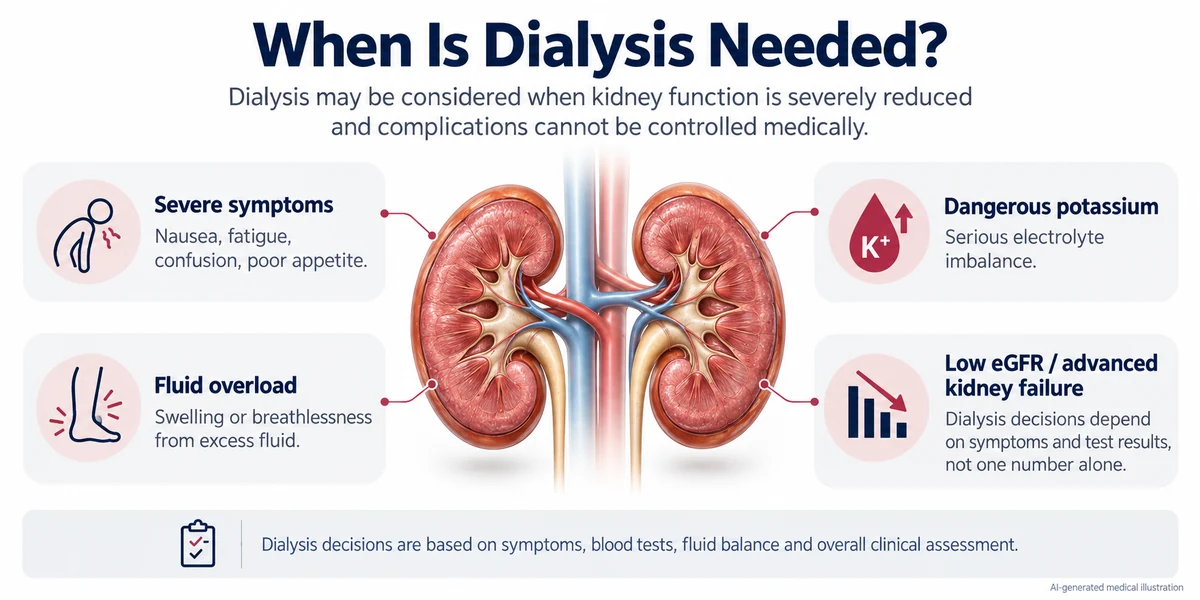
Dialysis may be needed when the kidneys can no longer adequately remove waste products, control excess fluid or maintain the body’s electrolyte and acid–base balance. It is considered in advanced chronic kidney disease and, in some situations, during acute kidney injury. The decision to start dialysis is not based on a single creatinine or eGFR value. Doctors assess symptoms, laboratory results, fluid balance, nutritional status and the patient’s overall medical condition. According to KDIGO guidance, dialysis initiation often occurs when eGFR is approximately 5–10 mL/min/1.73 m² in advanced chronic kidney disease, but this is not a fixed threshold. Some patients require dialysis earlier because of serious complications, while others can continue monitoring without dialysis for a period of time. What Is Dialysis? Dialysis is a medical treatment that helps remove waste products and excess fluid from the blood when kidney function is insufficient. Healthy kidneys help: – Filter waste products from the bloodstream. – Regulate body fluid balance. – Maintain appropriate electrolyte levels. – Support the body’s acid–base balance. – Contribute to blood pressure regulation. When the kidneys become severely impaired, waste products and fluid may accumulate, leading to potentially serious complications. Dialysis replaces some of the kidneys’ filtering functions, but it does not perform every function of a healthy kidney. When Do Doctors Recommend Starting Dialysis? The decision to begin dialysis depends on the clinical condition rather than a fixed laboratory number. Dialysis may be recommended when kidney failure is associated with complications that cannot be adequately controlled through appropriate medical treatment. Important indications include: 1. Severe Symptoms of Uremia Uremia occurs when substances normally removed by the kidneys accumulate in the body. Possible symptoms include: Persistent nausea or vomiting. – Significant loss of appetite. – Unexplained weight loss. – Severe itching. – Marked fatigue or weakness. – Difficulty concentrating or confusion. These symptoms may have causes other than kidney failure. Medical evaluation is needed to determine their significance. Severe neurological complications attributable to uremia may require urgent dialysis. 2. Excess Fluid That Cannot Be Controlled When kidney function declines, excess fluid may accumulate in the body. Signs can include swelling of the legs, difficulty breathing or fluid accumulation in the lungs. Severe fluid overload, particularly when breathing is affected and medical treatment is insufficient, may require urgent dialysis. 3. Dangerous Potassium Levels Potassium is an electrolyte involved in normal muscle and heart function. When kidneys cannot remove sufficient potassium, levels may become dangerously elevated. Severe hyperkalemia can cause abnormal heart rhythms and may become life-threatening. Dialysis may be required when hyperkalemia is severe, persistent or not adequately controlled with other emergency treatments. 4. Severe Metabolic Acidosis Healthy kidneys help maintain the body’s acid–base balance. When kidney function becomes severely impaired, acid can accumulate in the bloodstream. Severe metabolic acidosis that cannot be adequately managed with other treatments may require dialysis. 5. Other Complications of Kidney Failure Additional reasons for considering dialysis include: – Uremic pericarditis, involving inflammation around the heart. – Persistent neurological symptoms attributable to kidney failure. – Progressive nutritional deterioration despite appropriate management. – Inability to control fluid status or blood pressure. Not everyone with these symptoms needs dialysis, and the urgency depends on the medical assessment. What eGFR Level Indicates That Dialysis May Be Needed? Estimated glomerular filtration rate (eGFR) is a measure used to estimate how effectively the kidneys filter blood. Lower eGFR values generally indicate reduced kidney filtration. Understanding eGFR Categories eGFR (mL/min/1.73 m²) Kidney function category 90 or above Normal or high 60–89 Mildly decreased 45–59 Mildly to moderately decreased 30–44 Moderately to severely decreased 15–29 Severely decreased Below 15 Kidney failure range An eGFR below 15 is associated with CKD category G5 when the reduction is chronic. However, an eGFR below 15 does not automatically mean dialysis must begin immediately. For many people with advanced chronic kidney disease, dialysis begins when clinically significant symptoms or complications develop, often at an eGFR around 5–10. Some people need dialysis at a higher eGFR because of serious complications. Others may remain clinically stable without immediate dialysis. The timing is individualised. Learn more about the eGFR Kidney Function Test. Does High Creatinine Mean Dialysis Is Needed? No. An elevated serum creatinine result alone does not determine the need for dialysis. Creatinine levels are influenced by kidney filtration, muscle mass and other factors. Doctors interpret creatinine alongside: – eGFR and changes over time. – Blood potassium and bicarbonate. – Fluid balance and urine output. – Clinical symptoms. – The cause of kidney dysfunction. – Response to medical treatment. A person with high creatinine may not require dialysis, while someone with a less dramatically elevated creatinine level may need urgent treatment because of severe complications. Read more about What Causes High Creatinine. Can Dialysis Be Needed in Acute Kidney Injury? Yes. Dialysis may be required temporarily during severe acute kidney injury (AKI). AKI involves a sudden reduction in kidney function, potentially caused by severe infection, reduced blood flow to the kidneys, urinary obstruction or certain medicines. Dialysis may be considered in AKI when serious complications occur, such as: – Dangerous potassium abnormalities. – Severe metabolic acidosis. – Fluid overload affecting breathing. – Certain uremic complications. In selected cases of poisoning, dialysis may also be used to remove particular toxins. The need for dialysis in AKI depends on the type and severity of complications, not simply how rapidly creatinine has increased. Is Dialysis Permanent After Acute Kidney Injury? Not always. Some patients recover sufficient kidney function after the underlying cause of AKI has been treated and may no longer need dialysis. Others develop persistent kidney impairment and require ongoing treatment. Recovery depends on the cause, severity and duration of AKI, previous kidney function and other medical conditions. What Are the Different Types of Dialysis? There are two main forms of dialysis used for kidney failure: hemodialysis and peritoneal dialysis. Hemodialysis Hemodialysis uses a machine and an external filter, called a dialyzer, to remove waste products and excess fluid from the blood. Blood passes through the filter and