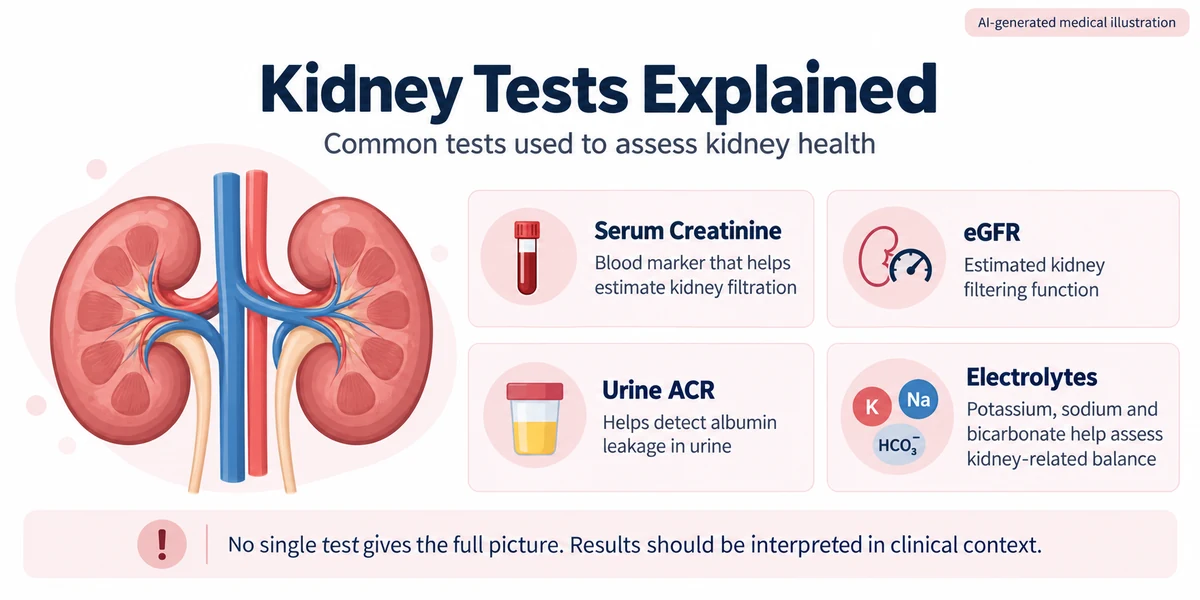
Kidney function tests help assess how effectively the kidneys filter waste products, regulate fluid balance and maintain essential electrolytes in the body. Common investigations include serum creatinine, estimated glomerular filtration rate (eGFR), urine albumin-to-creatinine ratio (uACR), blood urea nitrogen (BUN) and electrolyte measurements. These tests provide different types of information. Some measure substances in the blood, while others detect abnormalities in urine. The two key tests used to detect and monitor chronic kidney disease are eGFR and urine ACR. Additional investigations may help evaluate electrolyte disturbances, the possible cause of kidney dysfunction and associated complications. Understanding what each test measures can help patients interpret their reports more accurately, although laboratory results must always be considered alongside medical history and clinical findings. Why Are Kidney Function Tests Important? According to the National Institute of Diabetes and Digestive and Kidney Diseases (NIDDK), blood and urine tests can help identify kidney abnormalities even when noticeable symptoms are absent. The kidneys perform several essential functions, including: Removing waste products from the bloodstream. Regulating fluid and electrolyte balance. Helping maintain the body’s acid–base balance. Contributing to blood pressure regulation. Supporting red blood cell production through hormone activity. Helping regulate bone and mineral metabolism. When kidney function becomes impaired, waste products or electrolytes may accumulate or fall outside expected ranges. Kidney disease often develops without noticeable symptoms, particularly in its early stages. Blood and urine tests can identify abnormalities before symptoms become apparent. However, abnormal results do not always indicate permanent kidney damage. Temporary illness, dehydration, medicines and other factors may influence laboratory measurements. What Are the Main Tests Used to Check Kidney Health? Kidney investigations can be divided into tests of filtration, urine abnormalities and complications. Kidney Test What It Measures Why It Matters Serum Creatinine Creatinine concentration in blood Helps estimate kidney filtration eGFR Estimated kidney filtering function Helps assess and classify reduced filtration Urine ACR Albumin relative to creatinine in urine Helps detect albumin leakage Urinalysis Protein, blood and other urine findings Helps identify urinary or kidney abnormalities Blood Urea Nitrogen (BUN) Urea nitrogen concentration in blood Provides additional information alongside other findings Potassium Blood potassium concentration Identifies potentially important electrolyte disturbances Sodium Blood sodium concentration Helps assess water and electrolyte balance Bicarbonate Blood bicarbonate concentration Helps evaluate acid–base balance Calcium and Phosphorus Mineral concentrations May help assess complications of kidney disease Important: Not every person requires every test. The appropriate investigations depend on individual risk factors, symptoms and clinical findings. 1. Serum Creatinine Test: What Does It Measure? Creatinine is a waste product formed during normal muscle metabolism. The kidneys remove creatinine from the bloodstream, mainly through filtration. Serum creatinine may increase because of reduced kidney filtration, dehydration, certain medicines or other factors. Read more about What Causes High Creatinine and how abnormal results are evaluated. measures its concentration in blood. When kidney filtration declines, creatinine often increases. However, serum creatinine is not a direct measurement of kidney damage. What Is a Normal Creatinine Level? Reference ranges vary according to laboratory methods and individual characteristics. Illustrative adult ranges used by some laboratories include: Group Approximate Creatinine Range Adult Men 0.7–1.3 mg/dL Adult Women 0.6–1.1 mg/dL Important: These values are general examples. The reference range on the laboratory report should be used for interpretation. A creatinine result can be affected by: – Muscle mass. – Age. – Recent intense physical activity. – Cooked meat consumption. – Creatine supplementation. – Certain medicines. – Kidney filtration and hydration status. Someone with relatively low muscle mass may have reduced kidney function without a markedly elevated creatinine result. Similarly, a person with high muscle mass may have a higher creatinine level without necessarily having kidney disease. What Does High Creatinine Mean? High creatinine may result from reduced kidney filtration associated with: – Acute kidney injury. – Chronic kidney disease. – Significant dehydration. – Urinary tract obstruction. – Other medical conditions affecting kidney function. It may also be influenced by non-kidney factors. Read more about What Causes High Creatinine. Important: A single high creatinine reading does not establish kidney failure or determine the need for dialysis. 2. eGFR Test: How Well Are the Kidneys Filtering Blood? The eGFR Kidney Function Test helps estimate kidney filtration and provides useful information when evaluating chronic kidney disease. In adults, eGFR is commonly calculated using serum creatinine, age and sex through a validated estimating equation. The result is usually reported in mL/min/1.73 m². eGFR provides a more useful estimate of kidney filtration than serum creatinine alone in many clinical situations. However, it remains an estimate and has limitations. Understanding eGFR Results eGFR (mL/min/1.73 m²) Category General interpretation 90 or above G1 Normal or high 60–89 G2 Mildly decreased 45–59 G3a Mildly to moderately decreased 30–44 G3b Moderately to severely decreased 15–29 G4 Severely decreased Below 15 G5 Kidney failure range An eGFR below 60 that persists for at least three months meets one criterion for chronic kidney disease. However, an eGFR of 60 or above does not establish CKD unless there is other evidence of kidney damage. Can eGFR Change Between Tests? Yes. eGFR may change because of: – Acute illness. – Changes in kidney function. – Laboratory variation. – Medicines. – Changes in creatinine production. – Hydration-related effects. Small differences between test results do not always mean kidney disease is progressing. Clinicians consider trends over time rather than interpreting every change in isolation. What Are the Limitations of eGFR? Creatinine-based eGFR may be less accurate in certain situations, including: – Unusually high or low muscle mass. – Rapidly changing kidney function. – Certain changes in diet or nutritional status. – Selected medical conditions affecting creatinine production. In some cases, clinicians may use cystatin C, another blood marker, to obtain an additional estimate of kidney filtration. Combined creatinine and cystatin C equations can improve estimation accuracy in appropriate clinical circumstances. Read more about the eGFR Kidney Function Test. 3. Urine ACR Test: How Is Albumin Leakage Detected? The urine albumin-to-creatinine ratio (uACR) measures the amount of albumin relative to creatinine in urine.